
Honors College at SOU Students Serve Community

SOU LOGO HZ 186 POS
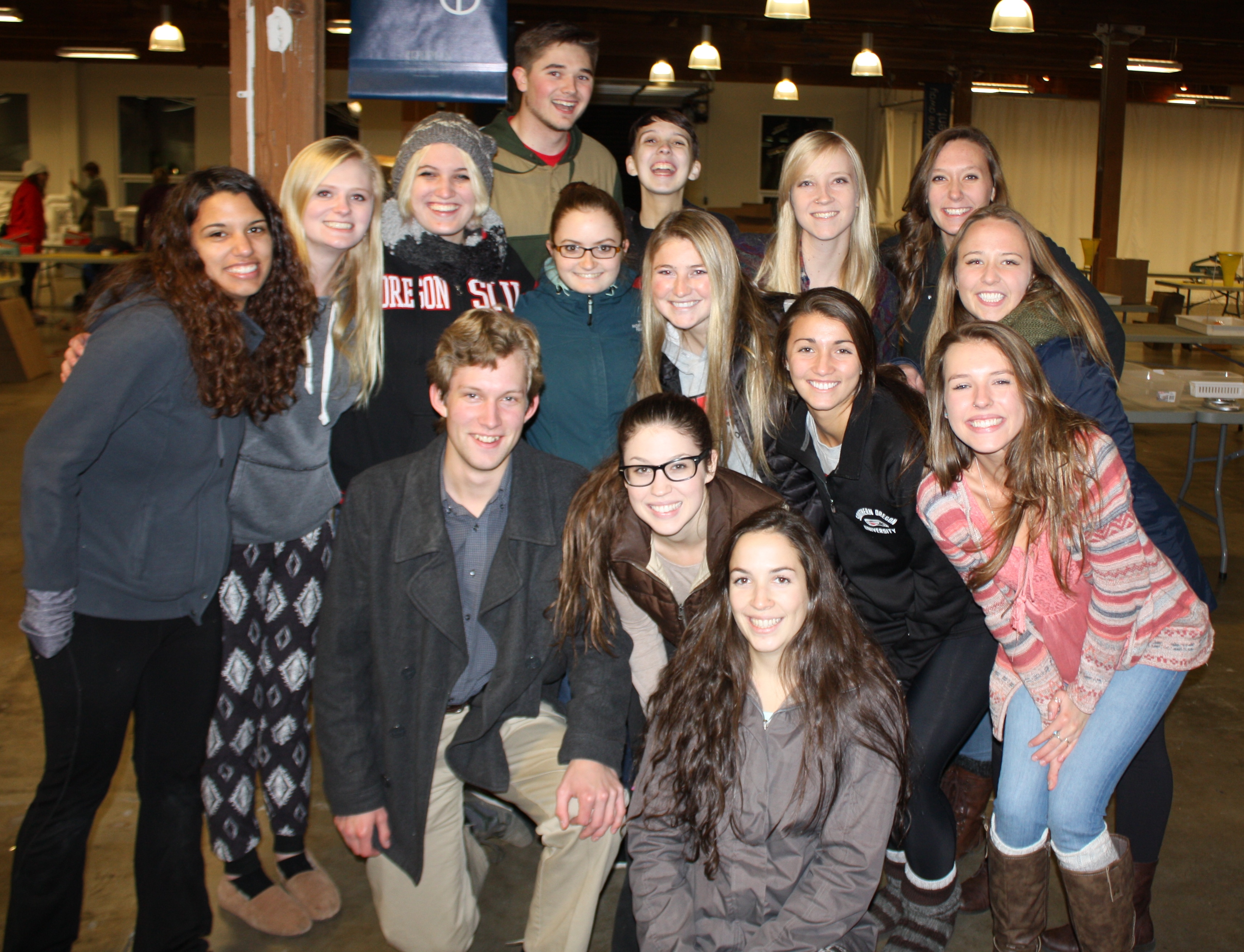
(Ashland, Ore.) — Forty-seven students from the Honors College at Southern Oregon University traveled to Portland recently, where they—along with approximately 1,000 other volunteers—participated in the Table For Two event held at Freeman Motor Company.
The students and other volunteers collectively packaged approximately 260,000 meals, each containing a nutritional combination of beans, rice, soy, and vitamins. Half of the meals went to the Oregon Food Bank, while half are destined for Rwanda. Honors College at SOU students partnered with two service organizations, Numana and Africa New Life, which provided funding for the purchase of the bulk food supplies and transportation of the packaged food.
“An integral aspect of the Honors College curriculum is community service,” according to Dr. Ken Mulliken, Director of the Honors College at SOU. “In addition to being a learning experience, this was very meaningful service for these students.”
The Honors College at SOU, now in its second year, accepts students from every major and allows for a customizable academic plan. All qualifying students who are accepted into the Honors College receive a scholarship.
In addition to service to the community, Honors College students also learn outside of the classroom with real-world experiences. “Every honors student works with a community mentor—a local professional working in a field of interest to the student,” Mulliken said.
“This is more than just networking; it’s an exploration of the uncharted world of life after college. Students will graduate with the necessary skills and experience to feel at home in a professional environment,” He continued. Honors College students work with their community mentors on applied research or other project which is then presented to members of the University and community upon completion.
SOU is accepting applications now through Jan. 16, 2015, for the 2015 cohort of Honors College Scholars. High school seniors and graduates, as well as transfer students who have not progressed beyond their sophomore year of college are eligible for consideration.
Priority consideration for admission into the Honors College will be given to those applicants who have a 1,200 combined critical reading and math SAT score with neither section below a 500, or a 27 overall ACT score with scores of at least 22 on both the math and English sections; and a cumulative GPA (high school and/or college) of 3.75 or higher, though Mulliken says students who don’t meet those qualifications are still encouraged to apply. “We look at the totality of each applicant: their personal interests, skills, previous community service, hobbies, and more,” he said. “We want students who will not only succeed academically, but who will contribute to the various aspects of the Honors College experience.”
For more information, or to apply, prospective students can visit honorscollege.sou.edu.
-SOU-
Honors_College_01
About Southern Oregon University
Southern Oregon University provides outstanding student experiences, valued degrees, and successful graduates. SOU is known for excellence in faculty, intellectual creativity and rigor, quality and innovation in connected learning programs, and the educational benefits of its unique geographic location. SOU was the first university in Oregon—and one of the first in the nation—to offset 100 percent of its energy use with clean, renewable power, and it is the first university in the nation to balance 100% of its water consumption. Visit sou.edu.
About the SOU Honors College
Combining real world projects with intellectual rigor, The Honors College at Southern Oregon University aims to provide a challenging learning environment. Our creative curricula will take advantage of the university’s unique location by drawing on the rich natural, cultural, and artistic resources that are Southern Oregon. Visit honorscollege.sou.edu.

SOU Wind Ensemble offers "Seasons Greetings"

 
SOU LOGO HZ 186 POS
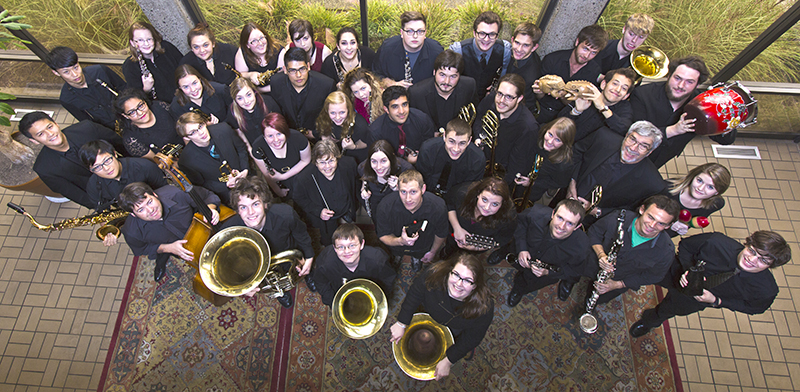
(Ashland, Ore.) – The Music program of the Oregon Center for the Arts at Southern Oregon University presents “Seasons Greetings,” a collection of holiday favorites performed by the SOU Wind Ensemble on Thursday, December 4 at 7:30 p.m. in the SOU Music Recital Hall.
This concert showcases the large wind ensemble at Southern Oregon University, under the direction of Dr. Cynthia Hutton. The SOU Wind Ensemble will perform “’Twas the Night Before Christmas,” with Sarah Wright, a Theatre Arts major, narrating the well-known poem. The concert includes selections from the Renaissance composition “Danserye” and “Patapan,” a traditional carol; Russian Christmas Music; selections from “The Nutcracker;” and “Sleigh Ride.” The concert also features the Brass Consort and Siskiyou Saxophone Orchestra.
“All who enjoy band music with a holiday twist will enjoy this concert,” said Hutton. “I especially encourage all members of our community bands and folks who support the SOU wind and percussion collaborations to attend this concert.”
The SOU Wind Ensemble has approximately 45 members and is opened to talented student musicians from all campus disciplines. It is dedicated to the study of a diverse repertoire for winds and percussion from masterworks to recent commissions of new compositions. The SOU Wind Ensemble has performed for the Oregon State Music Educators Association Conference, the Lawrence R. Sutherland Intercollegiate Wind Band Festival, the College Band Director Regional Conference and the Western International Band Conference.
G5A3693-small
Hutton is Associate Professor of Music at Southern Oregon University. She teaches classes in conducting, music theory, aural skills, brass methods and instrumental music education. In addition to her role at SOU, Dr. Hutton is the Music Director of the Youth Symphony of Southern Oregon and has served as Conductor of Youth Symphony and Youth Orchestra since 1995. She has served on the boards of the Oregon Music Educators Association and College Band Directors National Association, Northwest Division. As a horn artist, Dr. Hutton is a member of the Rogue Valley Symphony and the RVSO Brass Quintet.
Tickets are $10 general admission, $5 for senior citizens and free to full-time students. The Performing Arts Box Office is located in the Music Recital Hall lobby. Box office hours are noon to 6 p.m. Monday through Friday and two hours prior to each performance. Tickets can be purchased with a credit card over the phone by calling 541-552-6348 or online at sou.edu/performingarts. Contact the box office for discounts offered to SOU alumni, Osher Lifelong Learning Institute participants and SNAP/Oregon Trail cardholders.
About Southern Oregon University
Southern Oregon University provides outstanding student experiences, valued degrees, and successful graduates. SOU is known for excellence in faculty, intellectual creativity and rigor, quality and innovation in connected learning programs, and the educational benefits of its unique geographic location. SOU was the first university in Oregon—and one of the first in the nation—to offset 100 percent of its energy use with clean, renewable power, and it is the first university in the nation to balance 100 percent of its water consumption. Visit sou.edu.
-SOU-

SOU Enrollment Increases

SOU LOGO HZ 186 POS
(Ashland, Ore.) — Southern Oregon University has seen its enrollment climb to more than 6,200 students this fall, an increase of more than 1 percent compared to fall 2013. The enrollment numbers represent the first year-over-year increase in fall term enrollment since 2011.
The increase comes despite previous Oregon University System projections that predicted an enrollment decrease for SOU this fall. In order to overcome those dour projections, faculty and staff at SOU worked hard over the spring and summer to identify potential new students. With the enrollment increase, SOU bucks statewide and national trends, where university enrollment has experienced a general decline.
Two major factors in SOU’s enrollment increase are new transfer students and new freshmen coming into SOU. New transfers are up more than 8 percent from last year, while new freshmen have increased by about 10 percent, constituting the largest freshman class in the last 10 years at SOU.
“Students don’t decide to attend SOU by happenstance,” said Dr. Roy Saigo, SOU president. “These numbers reflect a lot of hard work by a lot of people. They also indicate that our programs and faculty are extremely well respected. Students want to learn from the best and leave with a degree that is valued. They know they will find both at SOU.”
SOU is now accepting applications for winter, spring, summer, and fall 2015 terms.
-SOU-
About Southern Oregon University
Southern Oregon University provides outstanding student experiences, valued degrees, and successful graduates. SOU is known for excellence in faculty, intellectual creativity and rigor, quality and innovation in connected learning programs, and the educational benefits of its unique geographic location. SOU was the first university in Oregon—and one of the first in the nation—to offset 100 percent of its energy use with clean, renewable power, and it is the first university in the nation to balance 100% of its water consumption. Visit sou.edu.
Learning to Coexist with Wildfire

SOU LOGO HZ 186 POS
November 6, 2014
(Ashland, Ore.) — Many fire scientists would like Smokey Bear to hang up his prevention motto in favor of tools like thinning and prescribed burns. These tools can manage the severity of wildfires while allowing them to play their natural role in certain ecosystems.
A new international research review, led by Max Moritz, an associate at UC Santa Barbara’s National Center for Ecological Analysis and Synthesis (NCEAS), and Southern Oregon University research ecologist Dennis Odion (also an associate project scientist at UCSB’s Earth Research Institute) says the debate over fuel-reduction techniques is only a small part of a much larger fire problem that makes society increasingly vulnerable to catastrophic losses unless it changes its fundamental approach from fighting fire to coexisting with fire as a natural process. The findings appeared this week in the journal Nature.
“We don’t try to ‘fight’ earthquakes — we anticipate them in the way we plan communities, build buildings and prepare for emergencies,” said Moritz, also a cooperative extension specialist in fire at UC Berkeley’s College of Natural Resources. “We don’t think that way about fire, but our review indicates that we should. Human losses will only be mitigated when land-use planning takes fire hazards into account in the same manner as other natural hazards such as floods, hurricanes and earthquakes.”
The review examines research findings from three continents and from both the natural and social sciences. The authors conclude that government-sponsored firefighting and land-use policies actually incentivize development on inherently hazardous landscapes, amplifying human losses over time.
The analysis examined different kinds of natural fires, what drives them in various ecosystems, the ways public response to fire can differ and the critical interface zones between built communities and natural landscapes. The authors found infinite variations of how these factors can come together.
“It quickly became clear that generic one-size-fits-all solutions to wildfire problems do not exist,” Moritz said. “Fuel reduction may be a useful strategy for specific places like California’s dry conifer forests, but when we zoomed out and looked at fire-prone regions throughout the western United States, Australia and the Mediterranean basin, we realized that over vast parts of the world, a much more nuanced strategy of planning for coexistence with fire is needed.”
The authors recommend prioritizing location-specific approaches to improve development and safety in fire-prone areas, including adopting land-use regulations and zoning guidelines such as restricting development in the most fire-prone areas, and building codes that require fire-resistant construction to match local hazard levels and encourage retrofits to existing ignition-prone homes.
The paper also suggests implementing locally appropriate vegetation management strategies around structures and neighborhoods; evaluating evacuation planning and warning systems, including understanding situations in which mandatory evacuations are or are not effective; and developing household and community plans for how to survive stay-and-defend situations as well as better maps of fire hazards, ecosystem services and climate change effects to assess trade-offs between development and hazard.

As an example of positive steps, the report cites new fire danger mapping efforts, including an existing fire hazard severity zone map that guides building codes in California. Produced by the state’s Department of Forestry and Fire Protection, the current map does not explicitly incorporate locally varying wind patterns, which influence the worst fire-related losses of homes and lives, but future iterations will include these data.
“Wildfires are a natural part of many ecosystems and can have a positive long-term influence on the landscape, despite people labeling them as disasters,” said co-author Dennis Odion. “They can often stimulate vegetation regeneration, promote a diversity of vegetation types as the intensity of fires varies, provide habitat for many species and sustain other ecosystem services, such as nutrient cycling. However, where exotic grasses are invading, fires may be harmful, so there is a need for site specific analyses.”
Odion is the lead author of another PLOS ONE paper published earlier this year that examined the frequency, size, seasonality, impacts and other characteristics of naturally occurring fires in Ponderosa pine and mixed-conifer forests of western North America. The findings show that prior to settlement and fire exclusion —the elimination of all types of wildland fire from a specified area — these forests historically exhibited much greater structural and successional diversity and as a result of fires burning with complex patterns of intensity. This is often the byproduct of weather patterns, as we see in modern wildfires. This can limit the effectiveness of fuel treatments, and is a reason why the kind of coexistence strategies described in Moritz et al. are needed.
“A different view of wildfire is urgently needed,” Moritz concluded. “We must accept wildfire as a crucial and inevitable natural process on many landscapes . . . there is no alternative. The path we are on will lead to a deepening of our fire-related problems worldwide and will only become worse as the climate changes.”

SOU Accounting Program Ranked No. 12 in Nation

SOU LOGO HZ 186 POS
November 5, 2014
(Ashland, Ore.) — Southern Oregon University’s Bachelor of Science in Business Administration with an accounting option has been ranked No. 12 in the nation for affordability among online bachelor’s degree programs in accounting, according to Accounting Degree Review (ADR).
According to ADR, more than 80 regionally accredited colleges and universities with online bachelor’s degrees in accounting were reviewed. The organization found “that there is a great selection of online degrees with reasonable prices,” its website states.
“Not every institution with an accounting degree offers an online option, and for-profit institutions often spend more on marketing,” said Dr. Greg Jones, Director of SOU’s Division of Business, Communication and the Environment. “These rankings shine some light on regionally accredited institutions, like SOU, that are making affordable accounting programs available online.”
SOU’s accounting option offers two tracks: Track I is designed for students wishing to pursue a career in any area of accounting—public, private, or governmental, while Track II is for students interested in accounting from a management and systems perspective. The certificate in accounting program benefits both traditional students and students with a baccalaureate degree who wish to complete coursework to prepare for certification examinations in accounting.
“The flexible schedule of the online program is in direct response to the need for this degree by professionals already working in the field,” according to Dr. Jones. “We are extremely pleased with this ranking and proud of the hard work and dedication of our faculty and staff working in the program.”
SOU is regionally accredited through the Northwest Commission on Colleges and Universities. The SOU School of Business is a member of the Accreditation Council for Business Schools and Programs, a leading specialized accreditation association for business education.
More information on SOU’s Bachelor of Science in Business Administration with accounting option is available online at www.sou.edu/business/undergrad.

SOU to Host Forum on Biomass Cogeneration Conversion

SOU LOGO HZ 186 POS
November 4, 2014
(Ashland, Ore.) — As part of an ongoing effort to become 100 percent carbon neutral by 2050, Southern Oregon University is considering replacing its existing natural gas-fired steam boilers with a biomass cogeneration facility that would provide the University’s main campus with heat while producing electricity that could be sold back into the power grid. A biomass cogeneration system would be more economical than maintaining the current system, would reduce reliance on fossil fuels, and would make a significant step toward SOU’s carbon emission reduction targets.
Two of the University’s four existing boilers are reaching the end of their useful life. SOU commissioned a series of studies to explore options to meet the increasing demand for campus heating. The reports found that a biomass cogeneration facility would have a range of environmental, social, and economic benefits.
Biomass fuel is a renewable resource that typically comes from forestry byproducts. Creating a use for this material reduces waste, improves forest health and emits far less carbon than would otherwise come from burning slash piles, prescribed burning, or wildfires. Biomass fuel is also cheaper than natural gas, resulting in lower operating costs. Because state and federal agencies are interested in the use of biomass as an alternative fuel source, it is likely that grant funds may be available to help offset the capital construction costs.
If the biomass cogeneration option does not move forward, the two outdated gas-fired boilers will be replaced in the next several years by a natural gas fired cogeneration facility. The University wants to hear from the community before making a decision on whether biomass cogeneration is right for SOU. Please join us at a community meeting on November 12 at 6 p.m. in the Rogue River Room inside Stevenson Union on SOU’s main campus. Visit the project website for more information: www.SOUcogeneration.org.

SOU CORE Program Receives Grant

SOU LOGO HZ 186 POS
October 31, 2014
(Ashland, Ore.) — Southern Oregon University is pleased to announce that CORE, the University’s Collegiate Recovery Program has been awarded a $2,500 grant to assist students in recovery from substance use disorders and other addictive behaviors.
The grant was awarded through Transforming Youth Recovery, a nonprofit organization founded in 2013.
The grant will provide Southern Oregon University with mid-stage funding to engage in a capacity building approach aimed at building the relationships necessary to better meet the needs of students in recovery on campus.
The grant also will support the creation of an online map of community recovery assets intended to facilitate a nation-wide network of resource sharing and collaboration among collegiate recovery practitioners, students and community members.
“We are excited to partner with Transforming Youth Recovery in expanding and strengthening the network of resources for recovering students,” said CORE director Victor Chang. “CORE enhances recovering students’ academic success and personal well-being as well as their recovery from addiction. Connecting members of the SOU community to available resources and one another goes a long way to enhancing recovery.”
In undertaking this project, the ultimate goal is to maintain a sustainable collegiate recovery program on campus that provides a safe, supportive, and fun environment for students in recovery from substance use disorders and other addictive behaviors.
To find out more information about CORE or to get involved, contact Victor Chang at (541) 552-6813 or changv@sou.edu or visit www.sou.edu/core.

SOU's 'Count Me In' Campaign a Success

SOU LOGO HZ 186 POS
October 24, 2014
(Ashland, Ore.) — The Southern Oregon University Foundation’s ‘Count Me In’ campaign for student scholarships was a great success, raising more than $210,000 for the SOU Scholarship. More than 400 alumni, faculty, staff, students and community members participated in the 100-hour campaign.
“The Count Me In campaign really brought the community together in support of SOU students,” said Eric Baird, Executive Director of the SOU Foundation. “Community partners Radio Medford, Jefferson Public Radio, KOBI 5, the SOU Digital Media Center, and Southwick Specialty Advertising helped the campaign become a reality.”
The SOU Scholarship is awarded to students based on financial need with preference given to those who are first in their families to attend college. It is designed to help students bridge the funding gap between other forms of financial aid and the cost of attendance at Southern Oregon University.
“Thanks to the inspirational gifts from Jed and Celia Meese, Lithia Motors, an anonymous donor and the rest of the more than 400 individuals who contributed, we collectively raised scholarship funds that will inspire and change the lives of many students,” Baird said. “We are very thankful for the support and look forward to awarding the SOU Scholarship.”

Four Honored at SOU President's Dinner

SOU LOGO HZ 186 POS
October 15, 2014
(Ashland, Ore.) — Four alumni of Southern Oregon University were honored during the fifth annual President’s Dinner Oct. 15 at the Inn at the Commons in Medford.
In addition to being a venue for recognizing outstanding alumni, this year’s President’s Dinner also launched the SOU Foundation’s “Count Me In” campaign to raise funds for student scholarships. Through the campaign, which will last only 100 hours, the Foundation hopes at least 500 individuals will make contributions of any amount to the Supporting Opportunities for Undergraduates (SOU) Scholarship fund.
“There is great need for scholarships for our undergraduate students,” said interim SOU President Dr. Roy Saigo. “Approximately 84 percent of our students require some form of financial aid, and more than 60 percent of our students from within Oregon are the first in their families to go to college.”
The campaign can be followed on social media by using the hashtag #SOUCountMeIn, or at countmein.sou.edu
Bryan DeBoer was honored as Distinguished Alumni of the Year. DeBoer graduated summa cum laude from SOU in 1988. He joined Lithia Motors, where he has worked in various corporate capacities, including mergers, acquisitions, and operations. In 2006 DeBoer was named Chief Operations Officer, then in 2012 Chief Executive Officer and President of Lithia Motors Inc., a position he still holds today.
Other honorees included Nicholas Grant, Beth Heckert, and Dr. Michael Parker, who received the Young Alumni, Alumni Service, and Excellence in Education Awards, respectively.
Musical entertainment throughout the dinner was provided by SOU student Nic Temple, the SOU Graduate Percussion Group, and the SOU Jazz Collective.

SOU Named Finalist for Campus Sustainability Award

SOU LOGO HZ 186 POS
October 13, 2014
(Ashland, Ore.) — Southern Oregon University is pleased to announce that it has been named a finalist for the Campus Sustainability Case Study Award, given annually by the Association for the Advancement of Sustainability in Higher Education (AASHE).
SOU is being considered for the award for its project, “Creating a Living and Learning Laboratory for Applied Sustainability and Campus Farm Through Collaboration and Student Engagement.”
According to SOU’s sustainability and recycling coordinator, Roxane Beigel-Coryell, the project is a collaborative effort between the campus and local community. “The SOU Center for Sustainability serves as a community resource for sustainability education,” she said. “It fosters sustainable business development, promotes interconnectedness, and facilitates leadership training through thoughtful learning and practice. We are extremely proud to be considered for this award among a very strong group of finalists.”
In addition to being a finalist for the Campus Sustainability Case Study Award, SOU will also serve as a host sponsor for AASHE’s 2014 Conference and Expo, taking place in Portland Oct. 26-29.
Themed “Innovation for Sustainable Economies and Communities, the AASHE annual conference is one of the most powerful forums for empowering higher education to lead the sustainability transformation. With nearly 2,000 participants, AASHE conferences are the largest stage in North America for higher education sustainability thought leadership. This year’s theme provides a multi-day conference that will focus on topics ranging from sustainable curriculums to waste elimination and everything in between.
“We are thrilled to bring exciting keynote addresses, including our featured keynote speaker, Annie Leonard, Greenpeace USA Executive Director and “Story of Stuff” creator to the annual Conference and Expo. Attendees can expect high-quality workshops, sustainability tours, the Student Summit, and more,” said Stephanie A. Herrera, Executive Director at AASHE. “Portland is the perfect location for the annual Conference and Expo. With an abundance of thought-provoking sessions as well as scenic bike routes, breathtaking scenery and more, we are confident that everyone will leave the conference feeling invigorated and ready to increase sustainability efforts.”
In addition to the featured keynote speaker, Annie Leonard, attendees can look forward to hearing Marcelo Bonta, founder of the Environmental Professionals of Color and the Center for Diversity & the Environment and Rob Bennett, founder and CEO of EcoDistricts.
SOU joins Edmonds Community College, Lane Community College, Lewis and Clark College, Pacific Lutheran University, Portland Community College, Portland State University, Seattle Colleges and University of Washington as campus hosts of the AASHE 2014 Conference and Expo.