

Funding for I-5 wildlife crossing gets green light
(Ashland, Ore.) — Good news arrived recently for Southern Oregon University researchers and others who have done preliminary work in the development of a wildlife crossing over Interstate 5 south of Ashland, when the Federal Highway Administration released key funding for the overpass.
Oregon was awarded a federal Wildlife Crossing Pilot Program (WCPP) grant of $33.2 million for the project in December 2024, but ODOT’s use of the funding was only recently finalized after many months of negotiation. Oregon senators Jeff Merkley and Ron Wyden pressed to fulfill the grant, which will be matched with $3.8 million from the Oregon Department of Transportation for a total project cost of $37 million.
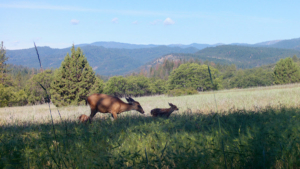 “This is a win not only for wildlife and driver safety, but also for the educational opportunities it will provide to Southern Oregon University students,” said Karen Mager, an associate professor in SOU’s Environmental Science and Policy program.
“SOU has been studying wildlife along I-5 for four years now to assist in planning this overpass,” Mager said. “We thank Senator Merkley and Senator Wyden for their work to secure this funding. We at SOU look forward to continuing our research to document the animals that use this wildlife overpass and share that information with the public.”
The Mariposa Wildlife Crossing – the first wildlife overpass anywhere on I-5, from Mexico to Canada – will span the freeway’s northbound and southbound lanes 1.7 miles north of the Oregon-California state line. Planning and construction of the overpass, directional fencing to funnel wildlife to the overpass and associated habitat improvements are expected to be completed no later than spring of 2029.
“This project will be instrumental in safeguarding all the special species that call the Cascade-Siskiyou National Monument home and protecting drivers from dangerous wildlife collisions,” said Senator Merkley, a senior member of the Senate Environment and Public Works Committee, where the budget request was recent reviewed.
“I’ll continue to champion smart federal investments that protect families, our natural treasures and the diverse wildlife that call them home,” Merkley said.
The Oregon Department of Transportation has been collaborating on the project with the Southern Oregon Wildlife Crossing Coalition. A vision for the wildlife crossing grew out of a February 2021 meeting of representatives from 17 organizations and agencies, including SOU, that are part of the coalition.
Mager and students in her SOU classes and paid research internships have used camera traps to study wildlife use of I-5, to better understand regional needs for wildlife crossings. Those camera traps have taken more than a million photos and videos – most triggered by wind – and SOU Computer Science and Environmental Science and Policy students have used AI to sift through the data, identifying and capturing more than 20,000 unique animal images.
The SOU-generated data was a key component in the feasibility study that identified the priority site for an overpass. The university’s monitoring efforts – and opportunities for research funding – are expected to continue for at least the next six to seven years, Mager said.
About 6,000 vehicle-wildlife collisions are reported each year throughout Oregon, according to state agencies. Data from six wildlife underpasses in Oregon – five under Highway 97 and one under Highway 20 – show that their construction led to an 86% decrease in wildlife-vehicle collisions in the areas near those underpasses.
The site of the I-5 overpass is considered to be the highest-priority location along I-5, due to its biodiversity and sensitive wildlife populations. The region is home to rare mammals such as the Pacific fisher, along with deer, bear, elk, cougars and other large-bodied animals – all of which have been observed at the site of the future overpass. Many rare and unique butterflies and other species are also found in the area.
-SOU-

