
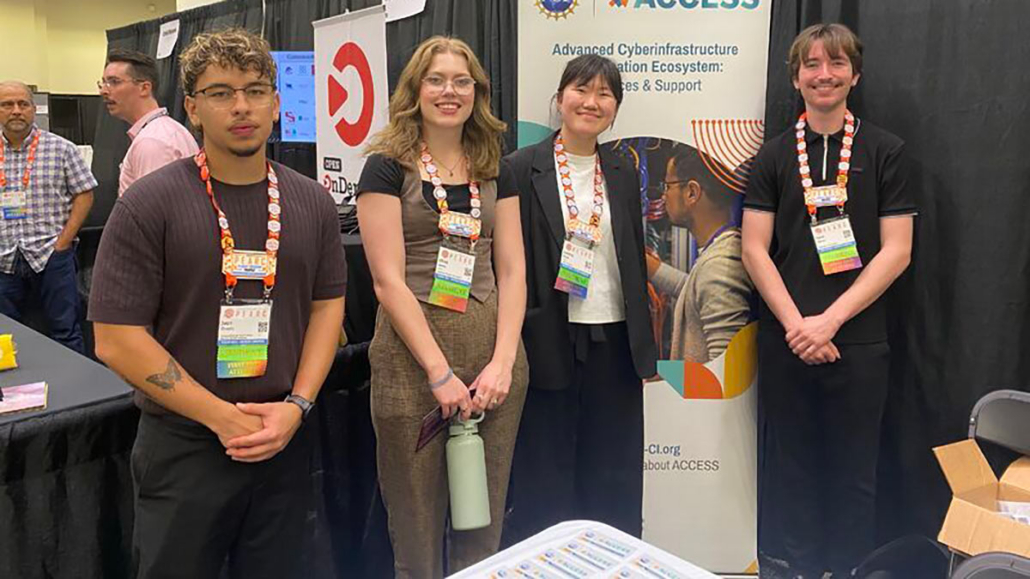
SOU undergrad Elliot Glenn gets hands-on cybersecurity experience
This past summer was an opportunity for SOU Computer Science student Elliot Glenn to take what she had learned in the classroom and apply it to real-world cybersecurity work.
Glenn spent the summer participating in the STEP program through ACCESS, gaining hands-on experience with cybersecurity, high-performance computing and cyberinfrastructure. The experience took her from orientation and training in Miami to eight weeks working with the National Center for Supercomputing Applications (NCSA) at the University of Illinois Urbana-Champaign.
“The experience of STEP was really great for my personal growth,” Glenn said. “Not only did I get to do actual work in my field of interest, cybersecurity, but I also got to practice working with a team, getting out of my comfort zone and learning to network.”
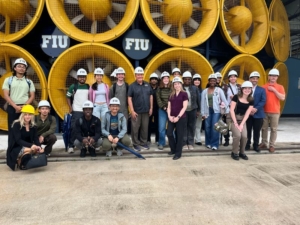
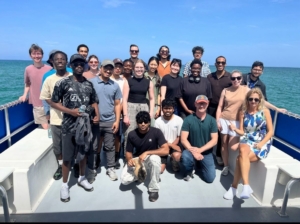 The program began with two weeks in Miami, where students were introduced to concepts they would need for the rest of the summer. They also had the opportunity to see how cyberinfrastructure supports research happening at Florida International University.
One of the experiences that stood out to Glenn was seeing research related to hurricane simulation and preparation. “It was really awesome research that we got to see,” she said.
Hands on security at NCSA
After Miami, Glenn traveled to the University of Illinois Urbana-Champaign, where she joined the NCSA security team. Much of her work focused on vulnerability management, including identifying new vulnerabilities that could affect NCSA systems, documenting possible mitigations and helping apply security updates.
Her work quickly became hands-on. Glenn built and secured Linux virtual machines on NCSA’s Radiant cloud platform, which uses OpenStack. She configured Linux environments, set up SSSD and LDAP authentication, applied local firewall rules and installed monitoring tools such as Qualys and Splunk.
She also ran Bash scripts to evaluate whether systems complied with NCSA’s baseline security policies.
Alongside that work, Glenn tackled a problem the security team regularly faced: sorting through large weekly cybersecurity bulletins to identify which vulnerabilities actually mattered to their systems.
The Cybersecurity and Infrastructure Security Agency, or CISA, publishes vulnerability information that can contain hundreds of entries. Reviewing those entries manually was time-consuming and made it harder to quickly separate relevant threats from unrelated ones. Glenn developed a Python tool to make that process more efficient.
The program she created scraped CISA bulletins, queried Red Hat APIs and filtered out vulnerabilities that did not apply to NCSA’s systems. Relevant vulnerabilities could then be turned into Jira tickets, giving administrators a clear way to track mitigation and patching work.
“The main hurdle was filtering out signal from noise in CISA’s massive weekly vulnerability feeds,” Glenn said. “Scrolling through hundreds of raw entries was inefficient and left room for critical risks to be missed.”
Turning that manual process into an automated workflow became one of her proudest accomplishments of the summer.
 “Combining my Python parsing script with Jira ticket creation allowed system administrators to receive quick, structured remediation steps without having to dig through raw data,” she said.
Glenn also wrote technical blog posts for system administrators that outlined mitigation and patching procedures. Through that work, she gained experience not only identifying security issues, but also communicating solutions to the people responsible for maintaining the systems.
Beyond the classroom
That practical experience was one of the biggest differences between STEP and learning cybersecurity in a classroom.
“Classrooms teach security theory, but STEP gave me real-world practice handling threat feeds, managing tickets in Jira and communicating fixes effectively,” Glenn said.
Throughout the summer, she worked with technologies including OpenStack, Linux, SSSD, LDAP, Qualys, Splunk, Python, Bash and Jira. She also developed skills in vulnerability triage, API filtering, system administration and technical documentation.
The experience extended beyond her day-to-day security work. Glenn toured six data centers during the summer and attended the PEARC conference in Minneapolis, where she had the opportunity to meet and talk with professionals working in high-performance computing.
“Getting to connect with HPC leaders and discuss the work in this field gave me a much clearer view of my long-term career path,” she said.
Glenn said her experiences at SOU helped prepare her for the program. Coursework gave her a foundation in Linux, networking and scripting, while her previous research and cybersecurity projects helped her become comfortable working more independently.
She pointed in particular to her work through SOU’s Summer Research Experience, or STEMReX, and her Capture the Flag development work with Computer Science faculty member David Pouliot.
“Learning to create your own schedule and self-motivation for work, as well as some of the tools and coding experience I gained, helped tremendously,” Glenn said.
What comes next
By the end of the summer, the experience had also helped clarify what she wants to do after graduation.
“It completely solidified my decision to focus on cybersecurity for HPC and also gave me a lot of interest in system administrator roles,” Glenn said.
Her involvement with the program has continued beyond the summer. During the academic year, she is participating in STEP-3, working remotely part-time with the Security Operations team at the National Center for Supercomputing Applications. The continued experience is giving her the opportunity to build on what she learned over the summer while deepening her understanding of cybersecurity within cyberinfrastructure.
That direction has already led to her next opportunity. After graduating from SOU, Glenn plans to join Pacific Northwest National Laboratory.
“So apply anyway,” she added. “You might be as surprised as I was.”
Story by Felicity Johnson, SOU Computer Science major

