
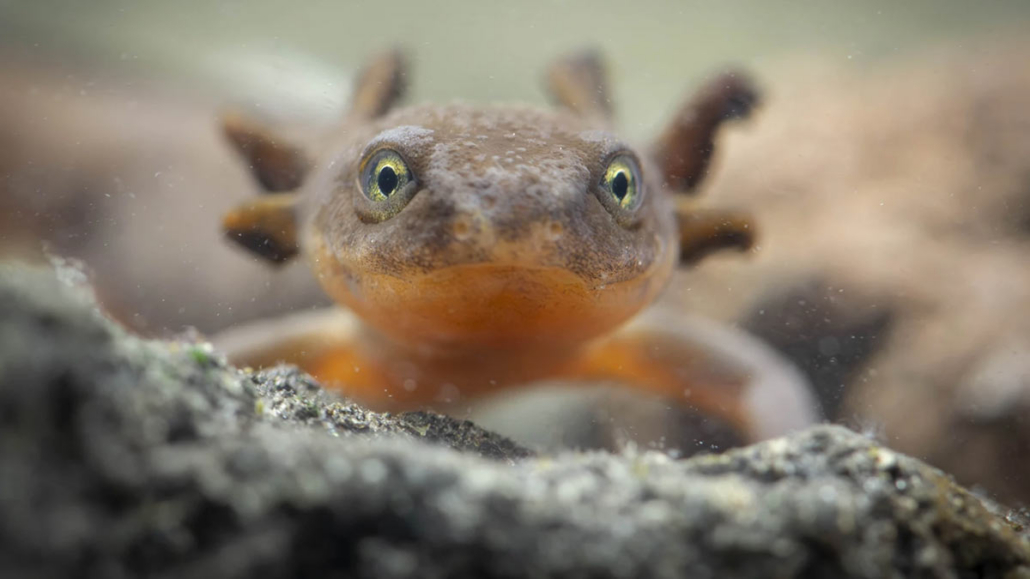
SOU students help protect Crater Lake’s rare Mazama newts
Southern Oregon University students are helping National Park Service and the Oregon Zoo in a joint project to address a growing ecological threat at Crater Lake National Park, where invasive signal crayfish have contributed to a sharp decline in the lake’s only native amphibian, the Mazama newt.
The conservation project combines student research, habitat assessment and captive breeding efforts to restore the rare newt to its natural environment. Researchers are also working to manage non-native crayfish and fish that threaten the lake’s delicate ecosystem.
National Park Service biologist Dave Hering, an SOU affiliate, is the park service’s lead on the project, and recommended the involvement of SOU students in the field work. Hering and several other NPS scientists and staff from the Klamath Inventory and Monitoring Program are housed at SOU, and the affiliation leads to occasional collaborations with university faculty members and recruitment of student workers.
“In this case, I was already collaborating with the Oregon Zoo on conservation of Mazama newts,” Hering said. “The Zoo approached me and asked about granting funds to support the project, and I suggested the grant be awarded to SOU.”
The Oregon Zoo initially granted $15,000 in June and then in September added about $13,000 with a second grant from the Zoo and the Oregon Department of Fish and Wildlife’s Conservation & Recreation Fund. One or the other of the agreements may be extended to continue the work next summer.
The Mazama newt is a subspecies of the rough-skinned newt, and is found only in the waters of Crater Lake’s caldera – making its survival a key to the health of one of Oregon’s most distinctive natural landmarks. For nearly 20 years, researchers have conducted annual snorkel surveys at designated locations throughout the lake, searching beneath rocks for newts. Over the past 10 to 15 years, those surveys have documented a significant decline. In summer 2026, researchers found no Mazama newts at the sites surveyed.
The decline coincides with the spread of signal crayfish, which were introduced to Crater Lake about a century ago to provide food for non-native fish. The crayfish have since become widespread, competing with native species and consuming a range of aquatic organisms.
Researchers have found that areas with signal crayfish have fewer of the invertebrates Mazama newts depend upon for food, including snails, amphipods and mosquito larvae. Surveys conducted this summer found crayfish at every study site and no newts.
The ecological consequences could extend beyond the newt itself. Researchers warn that if crayfish continue eliminating native invertebrates, the loss of organisms that help maintain the lake’s food web could contribute to declining water clarity. Crater Lake is renowned for its exceptionally clear, deep-blue water, but researchers have begun observing reduced clarity in some areas.
SOU students are helping researchers understand the conditions needed to restore the newt population. In 2026, Biology graduate Andrew Breeden, undergraduate students Rose Soto, Parker Burrill and Tyler Comer contributed to Hering’s projects. Breeden and Soto were assigned to the newt work, while Burrill and Comer assisted periodically.
The students are studying a small pool on Wizard Island, within the Crater Lake caldera, that researchers have identified as a potential location for reintroducing newts. The pool provides a controlled environment where researchers can evaluate release methods and monitor survival before attempting broader restoration.
“This work that we started – which involves not only studying the pool on Wizard Island, but also trying to remove nonnative fish and crayfish from the pool – will take at least another year to complete,” Hering said. “So I am hoping to find additional funds to keep it going and to keep using SOU students if possible.”
Over the next two years, students will assess the pool’s food resources, signal crayfish density and remaining trout populations, which could affect newly released amphibians. The overall project also includes captive breeding, with researchers and scientists from several universities conducting genetic studies to identify appropriate breeding pairs and ensure the offspring have the genetic diversity needed to establish a viable population.
Within nine months of beginning the effort, researchers achieved their first successful breeding of Mazama newts. Twenty-six larvae are now developing in captivity, representing the first generation researchers hope to return to Crater Lake.
Hering said the work will require sustained commitment. Complete eradication of signal crayfish is unlikely, but researchers hope to manage their populations and restore conditions that allow native species to survive.
The effort could continue for 20 to 30 years, with additional funding needed to maintain research and student involvement.
