
SOU-HECC-adult educational attainment

Oregon approves new adult educational attainment goal

(Salem, Ore.) – A new educational attainment goal for adult, working-age Oregonians has been announced by Oregon’s Higher Education Coordinating Commission.

The goal – specifically targeted to meet current and projected job opportunities – was developed by the HECC in partnership with the state’s Workforce and Talent Development Board. It aims to expand the number of degrees, certificates or credentials earned by adult Oregon residents by 2030 to 300,000 – a 50 percent increase over the 200,000 that are already projected.

“This goal will galvanize our statewide efforts to prepare Oregon working-age adults to take advantage of projected growth in family-wage jobs, to be resilient when the economy changes, and to ensure that our work is laser-focused on reducing attainment gaps for those who do not have equal opportunity today,” said Ben Cannon, the HECC’s executive director.

The adult educational goal is intended to foster economic mobility, supporting Oregonians in preparing for family-wage jobs of the future. The goal also recognizes a need to reduce attainment gaps for underserved populations through broad, inclusive approaches to skills and talent development.

The goal culminates a work group process that began nearly a year ago, following the passage of House Bill 2311 – which directed the HECC and WTDB to establish a statewide educational attainment goal for adult Oregonians. The workgroup was chaired by Neil Bryant, chair of the HECC, and by Ken Madden, chair of the WTDB. It also included representatives from Oregon’s public and private institutions, along with workforce and business partners.

“This is not just a postsecondary education system goal―this is a goal that will touch every community and every family in this state,” Bryant said. “Thanks to the Oregon Legislature, and the rigorous work of the workgroup and statewide experts, Oregon now has a meaningful, applicable goal for the postsecondary success of working adults.

“We thank all who contributed, and we look forward to moving forward to make this goal a reality.”

The new goal, approved at the HECC’s Nov. 8 public meeting, states:

“Oregon anticipates more than 120,000 additional jobs requiring post-secondary training or education between now and 2030. In order to meet this need, 300,000 additional adult Oregonians should earn a new degree, certificate or credential valued in the workforce during that time. Because Oregon has substantial attainment gaps among minority, low income and rural Oregonians, the state will also commit to reducing those attainment gaps by half during the decade.”

The most recent projections from the Oregon Employment Department show that over the next decade (2017-2027), more than 90 percent of job openings that pay more than $40,000 per year will require postsecondary education. The new adult attainment goal, in conjunction with Oregon’s 40-40-20 educational attainment goal for Oregon youth in the educational pipeline, is intended to guide progress in Oregon’s educational and workforce systems.

-SOU-
SOU-sustainability-carbon pricing

SOU president backs carbon pricing initiative

(Ashland, Ore.) — Southern Oregon University President Linda Schott has joined about 50 other college and university presidents across the country in calling upon elected officials to address climate change and hold polluters accountable by enacting carbon pricing measures.

The “Put A Price On It” campaign is sponsored by Our Climate, a national non-profit organization dedicated to empowering young people to advance effective climate policy. The group is tapping higher education leaders to help convince local, state and national decision-makers that greenhouse gas emissions can be effectively reduced through economic penalties.

“Sustainability and environmental responsibility are key parts of our identity at SOU,” President Schott said. “Our vision, mission and values refer to those principles, and one of our guiding ‘strategic directions’ establishes the goals of modeling and promoting sustainability, and integrating it into all that we do.

“This initiative provides us an opportunity to act on our institutional beliefs,” she said. “We are proud to stand up and be counted as a leader in the carbon pricing movement.”

Carbon pricing regulations require those who emit carbon dioxide to either pay a tax or buy permits based on the volume of their emissions. The policies make dirty energy less affordable, and encourage both energy conservation and use of sustainable energy sources.

Portland State University is the only other Oregon institution listed among the initiative’s backers.

SOU is one of 130 U.S. higher education institutions identified by the Our Climate organization as potential strategic partners in the carbon pricing campaign. President Schott signed the Our Climate endorsement letter after researching the campaign and consulting with the university’s sustainability team.

“This is something that fully aligns with SOU’s values and supports the goals outlined in our Climate Action Plan,” said Roxane Beigel-Coryell, the university’s sustainability and recycling coordinator. “Putting a price on carbon holds large greenhouse gas emitters accountable for their contribution to climate change. It provides incentive to implement climate solutions from the top down, instead of putting the responsibility solely on individuals.”

Carbon pricing policies have been implemented in more than 40 countries, provinces, states and other jurisdictions around the world. The World Bank has endorsed the practice as a means of compensating for direct and indirect costs of carbon emissions, ranging from crop loss and flood damage to heat-related medical costs.

“By making carbon-intensive industries pay a fair share of the costs of their pollution, we will have cleaner air and healthier communities, and prevent the most devastating effects of climate change,” said the Our Climate endorsement letter signed by President Schott and other higher education leaders.

-SOU-

SOU-Tulum ruins-Mayan

SOU summer field course to include Mayan Riviera trip

SOU’s Environmental Science and Policy program will mix academics with vacation-type fun in a field course next summer that will focus on marine biology, sustainable development and tourism.

The course, Ecoadventure: Mayan Riviera (ES 408), is worth six credits and will take place beginning in June on SOU’s campus, online and during an 11-day trip to Mexico’s Yucatan Peninsula. Vincent Smith, an associate professor and chair of Environmental Science and Policy, will teach the course.

“The course will focus on the impacts of tourism and development on the culture and environment of Mexico’s Mayan Riveira,” Smith said.

The total cost is expected to be about $4,000, including six credits of tuition for $990 and a trip fee of approximately $3,000 that will include airfare, lodging, food and ground transportation. The course is open to all students, regardless of their major.

The exact dates will be set during Winter Term, but the trip to Mexico is expected to leave the Medford airport around June 24.

The flight will land in Cancun, and several locations will be visited during the 11-day stay. Students will visit the Chichen Itza Mayan Ruins and take a walking tour of the historic city of Vallodolid. There will be plenty of time water play, including snorkeling at Cozumel and Tulum, and among cenotes (aquatic caverns). There will also be ziplining, Jeep tours, underground rafting, a hike through a spider monkey preserve and other activities.

Those who are interested in learning more about the field course are asked to fill out an online form to receive emails regarding trip updates, registration deadlines, exact costs and other details.

Smith has taught a number of classes at SOU and his research explores the coupled human-environment systems that shape the world. Smith’s work spans from human ecology to agroecology.

He enjoys working with students from a variety of backgrounds and is currently working with two undergraduate students on collaborative research.

For more information, view the course website or contact Smith at smithv3@sou.edu.

Story by Bryn Mosier, SOU Marketing and Communications intern

SOU-naloxone training-opioid

SOU training session addresses opioid use locally

Members of the SOU campus community are invited to participate in a training session on Wednesday that may prepare them to save the life of a friend, colleague or student experiencing an opioid overdose.

Students from the Oregon Health & Science University nursing program at SOU are offering a Naloxone Project training session from 11 a.m. to 3 p.m. on Wednesday in the Stevenson Union’s Rogue River Room. Participants will learn how to use naloxone to reverse opioid overdoses, and will receive free naloxone kits.

Anyone may attend, and admission is free.

“I sincerely wish that we had no need for this training at SOU – that the national opioid crisis could not reach our campus,” SOU President Linda Schott said Tuesday in a message to campus. “Tragically, that is not the case. We have lost students to overdoses, and there are others on our campus who are at risk.

“I encourage you to attend the naloxone training session,” she said. “You can be ready to save a life, if ever confronted with an overdose.”

Naloxone effectively treats overdoses by reversing opioid-caused depression to the central nervous system and respiratory system. It is safe, non-addictive and does not require a prescription.

The U.S. Centers for Disease Control estimated that more than 26,000 opioid overdoses were reversed through the use of naloxone kits from 1996 to 2014.

President Schott pointed out that much work must be done nationally to address the opioid epidemic, but said those at the local level can do their part “by preparing … to help those who would otherwise become its victims.”

Wednesday’s training session is supported by the HIV Alliance and Max’s Mission, a local nonprofit that offers free naloxone and raises awareness of the danger of drug overdoses. It was created by the parents of Max Pinsky, a 25-year-old Ashland man who was lost to an overdose five years ago.

Those who have specific questions about opioid use and treatment options for those with addictions may contact the Student Health and Wellness Center for more information.

SOU-musical-Into the Woods

“Into the Woods” to be featured on the Main Stage at SOU

“Into the Woods,” a musical about classic fairy tale characters and their lives after the stories, will be performed beginning this week on the Main Stage Theater at Southern Oregon University.

Based on the book by James Lapine, “Into the Woods” is a compilation of fractured fairy tales and is set to Stephen Sondheim’s music and lyrics. The show is just under three hours, including a 15-minute intermission.

Admission to “Into the Woods” is $5 for full-time students of any school. Students must purchase their tickets in person and show appropriate ID. General admission is $20, and $15 for seniors. The minimum age recommended for those attending the show is 8 years old.

Tickets can also be purchased online, by calling 541-552-6348, or by stopping at the OCA Box Office. The Box Office is open Monday through Friday, noon to 5 p.m.

“Into the Woods” will be performed at 8 p.m. Nov. 8 through 10 and Nov. 15 through 17. The musical will also be performed at 2 p.m. on Nov. 17 and 18.

Paul Barnes, an Ashland theatre veteran, is directing the musical masterpiece. Barnes was a founder of the Oregon Cabaret Theater and was education director for the Oregon Shakespeare Festival. He has also taught at college and university theatre programs, including at the University of Oklahoma’s Helemerich School of Drama and the University of San Diego’s Old Globe Theatre.

His most recent assignment for SOU’s Theatre Department was Our Town, in 2013.

Parking on the evenings of the “Into the Woods” performances will be free in the university lot on South Mountain Avenue and Henry Street. Contact the Oregon Center for the Arts at SOU Box Office with any questions, at (541) 552-6348.

Story by Bryn Mosier, SOU Marketing and Communications intern

SOU-Collier-Field Burns exhibition

Patrick Collier, visiting artist at SOU’s Schneider Museum of Art

Multidisciplinary artist Patrick Collier will give a visiting artist lecture from 12:30 to 1:20 p.m. on Nov. 7 in the SOU Art Building’s Meese Auditorium. He will also exhibit a selection of recent digital prints in the Schneider Museum of Art.

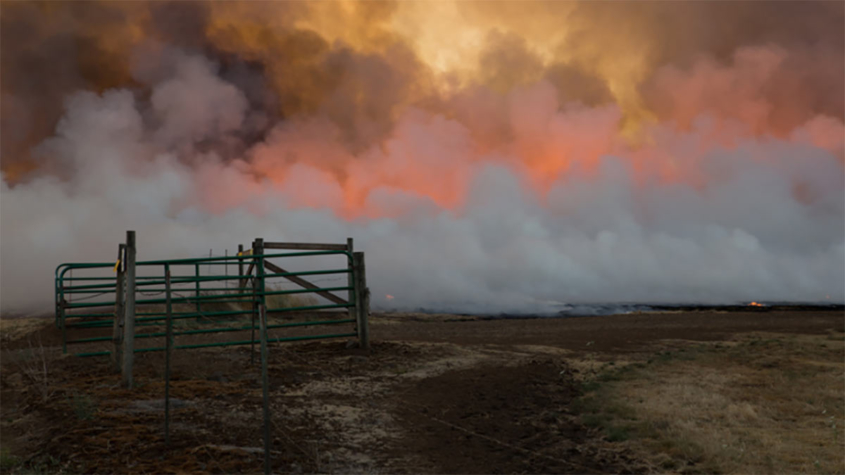
Collier’s current exhibition, “Field Burns,” shows both the power and beauty of the controlled burning of grass seed fields in Oregon’s Willamette Valley. Collier moved in 2003 from Chicago to the Willamette Valley, where he farms and works on his art.

“Field Burns” will be on display in the Schneider Main Gallery until Jan. 5. The landscapes provide viewers an opportunity to reflect on various regional agricultural and artistic issues, and to be inspired by the beauty of Collier’s compositions.

Another exhibition, “Outland About,” will be on display in the Schneider Museum’s Heiter and Treehaven galleries until Jan 5. It features the work of Carl Diehl and Susan Murrell, and is curated by Collier.

Collier has shown his art in several prestigious venues, including the Beret International Gallery in Chicago, the Walker’s Point Center for the Arts in Milwaukee and the Nine Gallery in Portland. He has presented frequently in Portland and Corvallis, but is best known for regionally for his critical writing in the online journal Oregon ArtsWatch.

He works in many disciplines, including photography, poetry, drawing, video, sculpture and installation. Collier’s artistic career has spanned nearly 25 years.

Collier has degrees in philosophy, literature and art. He studies at the University of Illinois in Chicago and Southern Illinois University in Carbondale.

Story by Bryn Mosier, SOU Marketing and Communications intern

SOU-Caroline Cabral-Snowden internship

SOU journalism student earns honor and experience

Aspiring journalist and SOU senior Caroline Cabral spent her summer break in southern Oregon chasing and reporting stories for the Herald and News, the daily newspaper in Klamath Falls.

She earned the paid internship as part of the prestigious Charles Snowden Program for Excellence in Journalism program, administered by the University of Oregon and committed to promoting ethical journalism across the state.

Cabral rose through a competitive assessment by Snowden administrators, including an in-person interview. Her hard work, established skills and rich background in student journalism then led her all over southern Oregon looking for stories, pitching ideas to the newspaper’s staff and writing as many as four articles per day.

Cabral received great experience, and two of her published stories were distributed by the Associated Press news agency.

Both of her AP stories took basic subjects and turned them on their heads. One documented disruptions to the entire Klamath Falls community that resulted from a new bike lane. Apparently, some people in Klamath Falls are trying to make residents healthy, even if it kills them.

In another featured story, Cabral took a new spin on the old subject of the county fair. She found that the new face of American carnivals includes many immigrants on H-2B visas, allowing them to work temporarily in the United States.

Cabral has picked up credentials at SOU, including serving for two years as co-editor of The Siskiyou, the university’s student newspaper, and helping to launch a weekly newsletter for the campus community. Cabral will be graduating with dual degrees in English and Communication, focusing in Strategic Social Media and Public Engagement.

“Journalism is really important for me,” Cabral said. “I also want to be a part of something bigger.”

SOU has now placed students in Snowden internships for three years in a row. Before Cabral, Eli Stillman earned the honor and interned with the Daily Astorian in 2016, followed by Hannah Jones at the McMinnville News-Register in 2017.

Story by SOU student writer Kyrie Hughes