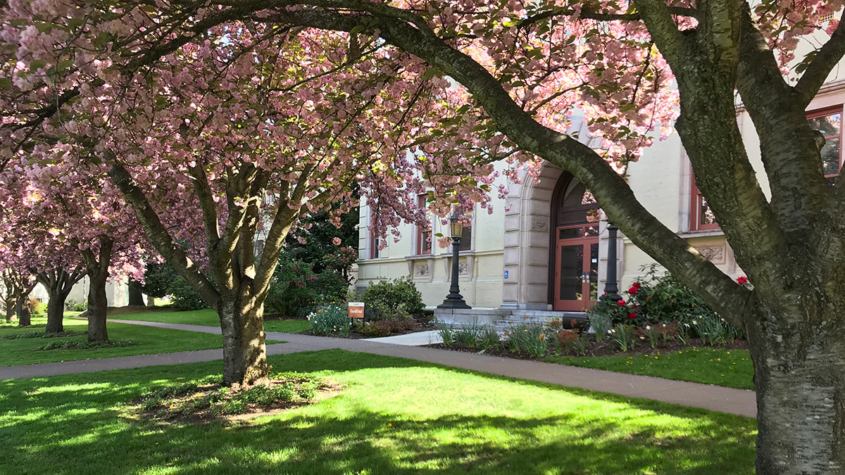
Ashland mural in Guanajuato

Ashland, SOU mark 50 years of Guanajuato “sister” relationships

(Ashland, Ore.) — Delegations from Guanajuato, Mexico, and the Universidad de Guanajuato will visit Ashland and Southern Oregon University in April to celebrate the 50th anniversary of their sister city and sister university relationships.

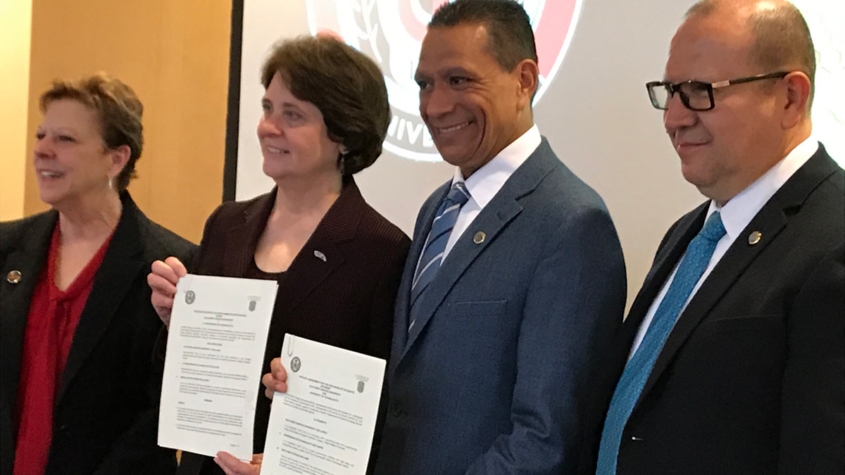
The celebration will include a formal renewal of the partnerships between the cities and universities, and is seen as an opportunity to recommit to the ideals that inspired the relationships in 1969.

“I hope each of us will see this 50-year anniversary as a waypoint at which we can pause, reassess and re-energize before continuing our journey together,” SOU President Linda Schott said in a statement to celebration participants. “Let’s contemplate the future, how our partnership relates to our changing world and what steps we should consider to keep our efforts fresh and relevant.”

On the university side, the multi-day celebration will be highlighted by an invitation-only reception and “gala concert” at the SOU Music Recital Hall on the evening of Tuesday, April 9. The concert will feature four new commissioned works from faculty at Oregon Center for the Arts at SOU, along with a composition by Javier Gonzalez Compean from Guanajuato.

Other university events involving the delegation from Guanajuato include breakfast, ceremonial re-signing of the sister university memorandum of understanding and an SOU campus tour on Monday, April 8. Universidad de Guanajuato Rector Luis Felipe Guerrero Agripino, who has a particular interest in crime prevention, will meet with faculty from SOU’s psychology and criminology departments.

Activities on Wednesday, April 10, include professional development opportunities for SOU faculty and members of the Guanajuato delegation, on the topics of transforming teaching and becoming universities for the future. There will also be an event at the International Peace Flame at SOU’s Thalden Pavilion.

The cooperative link between the two cities and the two universities is unique. Guanajuato is closer in size to Eugene than to Ashland, and Universidad de Guanajuato – which is larger than any university in Oregon – has sister university relationships with more than 300 other institutions worldwide.

But the Ashland-Guanajuato relationships – between both the cities and universities – were the first for each entity. More than 1,000 students, faculty members and others have participated in exchange programs and some families have been involved for three generations. More than 80 marriages have united partners from Ashland and Guanajuato.

In addition to the university activities, Guanajuato business, city government and community representatives will have the opportunity to explore and experience various elements and amenities of Ashland. Delegates from the Mexican city will see a performance of “Hairspray” at the Oregon Shakespeare Festival, and will celebrate the relationship with breakfasts, lunches and dinners hosted by churches, local organizations and service clubs.

The Ashland Chamber & Travel Ashland is sponsoring events at venues including the Ashland Art Center, ScienceWorks Hands-On Museum, Thalden Pavilion, Brickroom, Irvine & Roberts Vineyards and Mt. Ashland. The events will showcase Ashland’s economy and amenities, and some of the themes that unite Ashland and Guanajuato.

The City of Ashland has planned specific events and tours for Guanajuato’s official city delegation. The Amigo Club, a key partner in the friendship, is coordinating volunteer host families and has a large role in planning for the visit.

“Whenever I consider the sister city relationship between Ashland and Guanajuato, it warms my heart to think of all the friendships that have been built over the years,” said Sandra Slattery, executive director of the Ashland Chamber of Commerce. “Of course, the educational student exchange was the cornerstone for the creation of the relationship, but it truly expanded through the 50 years with the ‘people-to-people’ connections that were formed … even marriages!

“It’s been an honor, as the Chamber, to be coordinating and facilitating the steering committee for the celebration welcoming over 50 Guanajuato citizens to Ashland. May we welcome them with open arms as we work for future strengthened relationships and new partnerships to create peace and friendship in our world.”

Delegations from the city of Ashland and SOU will also participate in 50th anniversary festivities in Guanajuato from May 27 to 31.

The celebration will stretch into the summer as Ashland observes the anniversary as the theme for its 4th of July parade.

Individuals, businesses and organizations who have worked together on the celebration include the Ashland Chamber of Commerce, City of Ashland, Southern Oregon University, Amigo Club of Ashland, Ashland Art Center, Ashland Culture of Peace Commission, Ashland Fire & Rescue, Ashland Parks & Recreation, Ashland Police Department, Ashland School District, Ashland Springs Hotel, Barbara Tricarico, Brickroom, El Tapatio, Gathering Glass Studio, Grizzly Peak Winery, host families, Irvine & Roberts Vineyards, Karen & Allen Drescher, La Clinica, Lloyd M. Haines, Martolli’s Restaurant, Mt. Ashland, Oregon Center for the Arts at SOU, Oregon Shakespeare Festival, Our Lady of the Mountain Catholic Church, Platt Anderson Cellars, Rogue Valley Peace Choir, Rogue Valley Roasting Co., Rotary Clubs of Ashland, ScienceWorks Hands-on Museum, Southern Oregon Printing, Temple Emek Shalom, Travel Ashland and Weisinger Family Winery.

-SOU-

SRC solar installation-LEED Gold

SOU’s Lithia Motors Pavilion/Student Recreation Center strikes LEED Gold

(Ashland, Ore.) — Southern Oregon University’s Lithia Motors Pavilion and adjacent Student Recreation Center have earned LEED Gold certification by the U.S. Green Building Council, joining a growing list of SOU facilities to be recognized as sustainable.

The athletic pavilion and recreation center complex, which opened last spring, was awarded all 68 points that were sought on the Green Building Council’s LEED (Leadership in Energy and Environmental Design) checklist. The SOU facility was recognized for sustainability elements including a design that allows the capture and treatment of storm water runoff, significant reduction of both energy and water consumption, and building practices that diverted more than three-quarters of the construction waste away from landfills.

“This certification recognizes not only the hard work of our facilities staff and contractors, but also the dedication of our university to live and operate sustainably,” SOU President Linda Schott said. “Sustainability is an ideal that is expressed throughout our Vision, Mission and Values. It is a key part of who we are as a university, and it reflects our commitment to a better future for our students and region.”

The Lithia Motors Pavilion and Student Recreation Center facility is the fifth at SOU to achieve LEED certification, and a sixth application is in progress. The RCC-SOU Higher Education Center in Medford is LEED Platinum, which is the Green Building Council’s highest sustainability rating. The McLaughlin and Shasta residence halls, and The Hawk dining facility, all have been certified as LEED Gold, and LEED Silver certification is being sought for SOU’s recently renovated and expanded Science Building.

The nonprofit U.S. Green Building Council provides a sustainability rating system that takes into account elements of a building’s design, construction, operation and maintenance.

The athletic pavilion and recreation center complex was recognized for features including a bike-friendly infrastructure and electric vehicle charging stations, lighting that minimizes disturbances to night skies and wildlife, flush and flow plumbing fixtures that reduce water usage by 39 percent and efficiency measures that reduce energy consumption by almost 23 percent. Other elements that were cited include a rooftop solar installation that offsets 10 percent of the facility’s annual electricity consumption, the use of sustainable lumber products and recycled building materials, and the use of substances such as paints and sealants that emit only low levels of volatile organic compounds (VOC).

“SOU is excited to expand the campus inventory of green buildings with the LEED Gold-certified Lithia Motors Pavilion and Student Recreation Center,” said Roxane Beigel-Coryell, the university’s sustainability and recycling coordinator. “This certification celebrates the many green building strategies implemented that will support ongoing energy efficiency, water conservation and improved indoor air quality – as well as modeling SOU’s commitment to sustainability.”

-SOU-

SOU Honors College Cherstin Lyon

New director hired at SOU Honors College

(Ashland, Ore.) — Cherstin Lyon – a history professor and co-director of the Faculty Center for Excellence at California State University, San Bernardino – has been hired as director of the Southern Oregon University Honors College following a national search. She will begin work at SOU on July 31.

Lyon, who visited the university for interviews in January, will be the second director of the Honors College. She will succeed Ken Mulliken, who created the Honors College in 2013 and left last summer to take a position at the University of Illinois, Springfield.

“I am confident that this outstanding program is in good hands and that Cherstin will help guide it to new heights,” SOU Provost Susan Walsh said in announcing the hire to campus on Thursday.

Prakash Chenjeri, a philosophy professor at SOU who has served in various honors programs for many years, is currently interim director of the Honors College and will continue in that role until Lyon’s arrival.

Lyon has served on the CSU-San Bernardino faculty since 2006. She also serves as a faculty associate in CSUSB’s Office of Community Engagement and on the Program Transformation Committee for its University Honors program.

She has served previously as an instructor at the University of Arizona, an adjunct faculty member at Utah Valley University and a graduate teaching fellow at both the University of Arizona and the University of Oregon.

Lyon received her bachelor’s and master’s degrees in history from the UO, and her Ph.D. from Arizona. Her doctoral thesis was on “Prisons and Patriots: The Tucsonian Draft Resisters of Conscience Of World War II,” and she is author of the book, “Prisons and Patriots: Japanese American Wartime Citizenship, Civil Disobedience and Historical Memory.”

The Honors College at SOU, currently in its sixth year, accepts students from any major. All who are accepted into the Honors College participate in specialized programs and hands-on experiences outside the classroom.

-SOU-

Danny Santos-SOU Board of Trustees

Santos reappointed to SOU Board of Trustees

(Ashland, Ore.) — Daniel Santos – a Southern Oregon University alumnus and member of the university’s Board of Trustees – was notified today by Gov. Kate Brown today that he has been reappointed for a second four-year term on the SOU board.

Santos was appointed by the governor and confirmed by the Oregon Senate.

He is a retired associate dean for the Willamette University College of Law, where he oversaw student affairs and administration. He previously served in various capacities for four Oregon governors – Neil Goldschmidt, Barbara Roberts, John Kitzhaber and Ted Kulongoski. His roles included service as Roberts’ legal counsel and Oregon Board of Parole and Post-Prison Supervision chair, and as a senior policy advisor for Kulongoski.

Santos earned his bachelor’s degree in criminology at SOU in 1975, then received his law degree from the Willamette University College of Law. He has remained involved in education throughout his career, serving as a founding member of Scholarships for Oregon Latinos, and in guiding roles with Willamette University’s Willamette Academy for students from underserved communities and the Leadership Council for Oregon Mentors.

He also currently serves on the boards of directors of the Oregon Shakespeare Festival and the Mid-Valley Literacy Council.

SOU was granted authority by the state to form its own independent Board of Trustees beginning July 1, 2015, following the legislature’s dissolution of the Oregon University System and State Board of Higher Education. SOU’s board is responsible for governance and oversight of the university.

Eleven at-large trustees serve four-year terms, and one voting position each are reserved for an SOU student, a faculty and a non-faculty staff member – each of whom serve two-year terms.

Trustees are limited to serving two consecutive full terms. The university president serves in a non-voting, ex officio capacity on the board, bringing total membership to 15.

-SOU-

Consortium institutions discuss transfers-SOU

Consortium of southern Oregon colleges and universities to strengthen transfer agreements

(Ashland, Ore.) — Delegations from each of the institutions that make up the new Southern Oregon Higher Education Consortium will meet this month to discuss the seamless transfer of credits from colleges to universities and other matters of shared interest. The consortium members are Klamath Community College, Oregon Institute of Technology, Rogue Community College and Southern Oregon University.

The Feb. 25 event, 5:15 to 7:30 p.m. in the Rogue River Room of SOU’s Stevenson Union, will be an expanded version of the annual “Articulation Retreat” that counterparts from SOU and RCC have held for the past several years. This year’s version will include groups from Oregon Tech and KCC.

“We believe this event provides a wonderful opportunity for our SOHEC colleagues to build on what already is an enormously successful collaboration,” said SOU Provost Sue Walsh and RCC Vice President for Instructional Services Leo Hirner in their joint invitation to colleagues at the other institutions.

The consortium, a first-of-its-kind alliance of Oregon colleges and universities, is aimed at streamlining students’ educational pathways and addressing southern Oregon’s specific workforce needs. The ongoing collaborative effort took root with the four institutions’ presidents following a joint lunch meeting a year ago, and was announced in late November with signing events in both Klamath Falls and Medford.

SOHEC is considered a pioneering step toward preparing students and workforce members in the region for a rapidly changing future. It has been endorsed by state officials including the governor and the chair of Oregon’s Higher Education Coordinating Commission.

The Feb. 25 Articulation Retreat will be an opportunity for information-sharing by staff members from the SOHEC institutions’ enrollment services, admissions, academic advising, curriculum and other support services offices. The goal of the event is to improve and expand transfer programs and other cooperative agreements among the schools, to make it easier, faster and more affordable for students to transition from one degree program to the next.

Representatives of media outlets will be welcome to report on the evening’s discussions.

-88-

Scholarships-application-deadline

March 1 deadline approaches for more than 600 OSAC scholarships

(Salem, Ore.) – The Office of Student Access and Completion (OSAC) of Oregon’s Higher Education Coordinating Commission is encouraging Oregon students to apply for privately funded scholarships at OregonStudentAid.gov by the March 1 deadline.

Oregon students may explore more than 600 privately funded scholarships and apply for as many as 40 with a single application. There is no cost to apply, but students must submit their completed OSAC scholarship applicationsand all other required materials by 5 p.m. on March 1.

SOU students may also seek help with their financial aid options at the Financial Aid Office in Britt Hall, or on the university’s financial aid website.

SOU’s Financial Aid Office is urging current and future students to complete their Southern Online Scholarship Applications (SOSA) by March 15 for financial aid during the 2019-20 academic year. Completion of the SOSA form is required for those seeking any from a pool of scholarships – both need- and merit-based, for undergraduate and graduate students, and for Oregon residents and nonresidents.

The scholarship funding available through Oregon’s HECC office is for groups including graduating high school seniors, undergraduate and graduate students at colleges or universities, GED and homeschooled students, community college and vocational school students, and single parents returning to school. Details on specific scholarships that are available through HECC can be found on the OSAC Scholarship Catalog.

Students who want to be considered for federal or state financial aid, including grants and loans, must submit the Free Application for Federal Student Aid (FAFSA) or the Oregon Student Aid Application (ORSAA) in addition to the OSAC application. The ORSAA is Oregon’s alternative to the FAFSA for undocumented students, including students who have Deferred Action for Childhood Arrivals (DACA) status.

OSAC uses data from the FAFSA or the ORSAA to determine students’ eligibility for the Oregon Promise, the Oregon Opportunity Grant and numerous scholarships. Information from the FAFSA is also used to determine eligibility for federal aid, including the Federal Pell Grant, Federal Direct Loans and Federal Work-Study.

More information about deadlines and eligibility for the Oregon Promise and the Oregon Opportunity Grant is available at OregonStudentAid.gov. OSAC also hosts several webinars and resources for students, counselors, students, parents, and educators on financial aid opportunities.

–88–

SOU-French Dinner

SOU to host 23rd annual French Dinner

(Ashland, Ore.) — The Southern Oregon University French Club will serve its 23rd annual French Dinner – a five-course meal for students, employees and community members – on Thursday, Feb. 28.

The dinner, in the Stevenson Union’s Rogue River Room, is intended to promote French culture on campus and in the community. The dinner is organized by the university’s French Club, with the help of student union staff, French and other international students, and – for the first time – SOU athletes.

Doors will open at 6:30 p.m. and orders will be taken at 7 p.m.

Tickets – $9 for students and university employees, and $13 for other community members – can be purchased at the Stevenson Union information booth on campus or at Paddington Station in downtown Ashland. Whole tables of eight can be reserved by contacting Marianne Golding, an SOU foreign languages professor and faculty advisor to the French Club, at golding@sou.edu.

The dinner will begin with soup, followed by a palate cleanser, quiche, salad and cheese, French bread, dessert and coffee or tea. Vegetarian options are available for the soup and quiche courses.

Wine donated by prestigious Oregon wineries can be purchased at $3 per glass for those who are 21 and older.

-SOU-

environmental education-SOU

Master’s of environmental education at SOU: 50 years in

(Ashland, Ore.) — “Eventful” pretty well sums up the 1968-69 academic year: The decision was made at Yale University to admit female students. USC running back O.J. Simpson won the Heisman trophy. A music festival called Woodstock would be held during the summer. And Southern Oregon University launched its Master of Science in Environmental Education program – an ahead-of-its-time curriculum that would adapt, evolve and prepare hundreds for outdoors- and sustainability-related careers over the next 50 years.

“The program is committed to creating environmental leaders, and focused on staying modest in size to be able to present the highest quality,” said SOU professor Stewart Janes, one of the program’s current coordinators. “Our goal is to become more well-known, in an effort to be the go-to for environmental education in Oregon.”

SOU’s program has been unique in the state since its beginning – designed during the 1960s by biology professor Irene Hollenbeck to prepare elementary teachers to operate outdoor schools. Hollenbeck was an outdoor school pioneer, establishing the state’s first in 1957, and her curriculum at SOU (at the time, Southern Oregon College) was initially called the Master of Science in Outdoor Education program.

A lack of funding and support for outdoor schools in the 1980s put the program at a crossroads: it could either dissolve or be redesigned. Its then-directors, biology professors Ron Lamb and Don Mitchell, broadened it to serve additional purposes as the Master of Science in Environmental Education program beginning in 1990.

The program has produced about 300 degrees, and spawned careers with agencies including the U.S. Geological Survey, the Houston Zoo, the nonprofit Wimberley Valley Watershed Association in Texas and the Florida Fish and Wildlife Commission.

One notable member of the program’s 1985 cohort is Linda Hilligoss, who went on to create a nonprofit organization, teach elementary and middle school, and serve as the education coordinator at Crater Lake National Park’s Science and Learning Center. She returned to SOU as science education coordinator, and has served for the past 12 years as co-coordinator of the master’s in environmental education program with Janes.

“The accomplishments of all of our graduates are exemplified in the varied leadership roles they step into across the country,” said Janes, an environmental education professor.

The program focused in part on natural history and education as it transitioned during the early 1990s from its outdoor school roots toward its current emphasis on environmental education. A partnership between environmental education – at the time, part of the Biology Department – and the SOU School of Education had developed by the mid-2000s, enabling students in the department to take education courses. SOU also partnered with the nonprofit Siskiyou Field Institute to operate the Deer Creek Center – a field station near Selma with yurts and meeting facilities.

The partnership with SFI allowed SOU’s environmental education master’s students to present eight weeks of educational programs at the field station each fall. That served as underpinnings for the Fall in the Field capstone project, which remains a central element of the master’s degree program.

Fall in the Field has benefited from collaborations with the federal Bureau of Land Management, the Friends of the Cascade-Siskiyou National Monument, the Ashland Food Co-op and the Rogue Valley Audubon Society. SOU’s environmental education master’s students are now in their eighth year of an arrangement with the BLM to provide educational programing at the national monument.

Students in the 1 ½-year master’s degree program learn to create, market, manage and assess the effectiveness of their educational offerings. Their tasks range from curriculum development to arranging for on-location porta-potties.

The master’s program includes various other ongoing projects, including the offer of “Natural Science Kits” for loan to K-12 educators in Jackson, Josephine and Klamath counties. The kits have been available for more than 25 years, to provide teachers a no-cost opportunity bring the ecology of the Klamath-Siskiyou bioregion into local classrooms with curriculum developed by SOU’s environmental education students.

The SOU master’s program is the first in the Western U.S. and sixth overall to be accredited by the North American Association of Environmental Education. Representatives of the SOU program now serve in leadership roles to help other universities achieve accreditation and align with NAAEE standards.

The program is as vital and popular as ever as it passes its 50th anniversary, helping students address issues – both locally and globally – such as climate change and loss of biodiversity.

“Humans are the stewards of our planet, and as environmental educators it is our duty to increase awareness for the need for mindful stewardship while encouraging action,” said Crystal Nichols, a graduate assistant in the program.

-SOU-

Feetham-turnaround-SOU

Student set to complete turnaround after transfer to SOU

(Ashland, Ore.) — Southern Oregon University accounting student Mary Jane Feetham is on track to graduate next June and then take an exam to become a certified public accountant – the final step in a personal turnaround from near-homelessness and reliance on public assistance.

Feetham recognized that something had to change five years ago when she ended a relationship due to domestic violence and sought shelter at the Dunn House, a refuge operated by the Community Works nonprofit organization in Medford.

The first step was the hardest – she had to live without her three young children for two months while researching options and finding a safe place to live.

The second step was to find and accept help. An Oregon Department of Human Services caseworker helped her line up resources to pay a deposit, rent a place to live and qualify for food stamps. The Rogue Educational Achievement (REACH) project – another DHS program – helped her identify career goals, enroll at Rogue Community College, secure a travel voucher so she could afford the commute from Butte Falls and find day care for her children, who ranged in age from 2 months to 8 years.

“There are resources out there, but so many people don’t even know they have an opportunity,” Feetham said. “Generational poverty is pounded into people. These nonprofits (can) become their support.”

Feethan finished her associate degree at RCC and transferred to SOU, but continued to face obstacles – financial and otherwise – while commuting from Butte Falls for classes that began at 8:30 a.m. She collected cans for money, found free items on Craigslist and even learned on YouTube how to repair her car when it wouldn’t start.

But her turnaround was on track, and she was grateful for her education and the guidance she had received. She became involved in her community as a way of giving back, and that led to her participation in the 2017 Jackson County Community Needs Assessment. She wrote a report that identified unmet needs and gaps in community services, and the report is still being used by nonprofit organizations and city governments to determine where efforts should be focused.

“She is inspirational and proof that where there is a will, there’s a way,” said Joan McBee, an SOU business professor and department chair.

Feetham is now a board member for the Butte Falls Community School Partnership and president of the Butte Falls Active Club. She received aid from the U.S. Department of Health & Human Services’ Temporary Assistance for Needy Families program, and used some of that money to complete certifications through Oregon State University for grant-writing and nonprofit management. She landed a full-time grant-writing position with ACCESS, which serves low-income, disabled and senior populations in southern Oregon.

“I could write at home and earn a living while going to school,” Feetham said. “Eventually, I had to devote more time to school.”

Feetham – who has received a Ford Family Scholarship and 10 other grants or scholarships during her time at SOU – is now just a couple terms away from graduating, and is nearing her goal of working in the region and remaining involved in her local communities. She is serving as an intern with an accounting firm in the area and proudly points out that she is “breaking the mold of welfare recipients.”

-SOU-

About Southern Oregon University
Southern Oregon University is a medium-sized campus that provides comprehensive educational opportunities with a strong focus on student success and intellectual creativity. Located in vibrant Ashland, Oregon, SOU remains committed to diversity and inclusion for all students on its environmentally sustainable campus. Connected learning programs taught by a host of exceptional faculty provide quality, innovative experiences for students. Visit sou.edu.

audio-wayfinding-SOU

SOU subscribes to AWARE audio wayfinding app

(Ashland, Ore.) — SOU has partnered with the vendor Sensible Innovations to provide an audio wayfinding app for students, employees and visitors with sight impairments – and other users who like the convenience of audible navigation assistance.

The AWARE Audible Wayfinding app, which provides route directions to buildings and frequently visited locations on the SOU campus, can be downloaded for free from the App Store. The app was developed to help the visually impaired, but is also useful for new students or employees, visitors who are unfamiliar with campus, and others.

AWARE uses programmable “iBeacons” that are placed at various locations on campus as waypoints for users finding their way to both outdoor and indoor destinations at SOU. The beacons connect with smartphones and other mobile devices through Bluetooth Low Energy technology.

More than 200 beacons are currently in place at SOU, in often-used locations such as the Stevenson Union’s Rogue River Room, the Higher Education Center in Medford and at accessibility features such as elevators, building entrances and restrooms. The next phase of implementing the audio wayfinding service will add beacons to new and remodeled buildings including the Lithia Motors Pavilion, Student Recreation Center and Theater Building, and will bring the total to about 300.

Users of the AWARE app can choose whether to read directions or hear them, using the accessibility features on their mobile devices.

Rasha Said – a former actuarial and financial analyst with a background in mathematics and computer science – founded Illinois-based Sensible Innovations as a new standard for visually-impaired services. She is the mother of a visually-impaired child.

The audio wayfinding app is expected to be particularly helpful for universities and transit systems, but the nine initial venues posted on the Sensible Solutions website suggest a wider spectrum – ranging from the Chicago Lighthouse to the Vision Forward Foundation in Wisconsin. Wright State University in Ohio is also listed among the company’s clients.

-SOU-