Student Sustainability Center director, McNair Scholar wins Scholastic Achievement Award
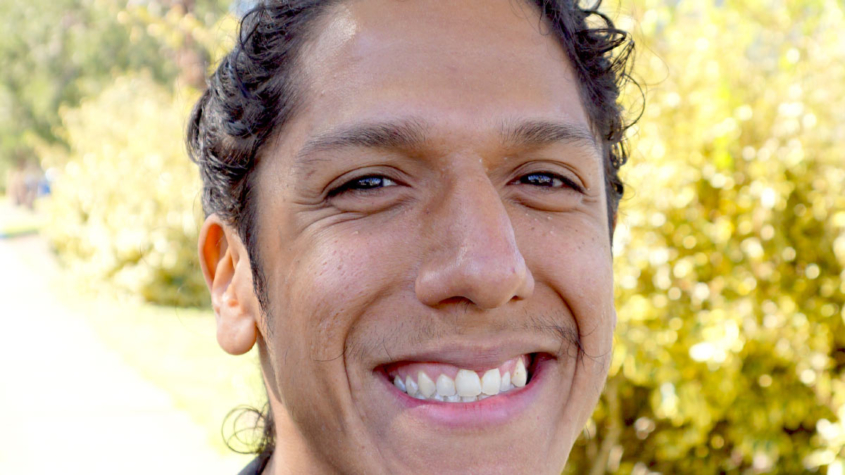
Luis Berrios-Hayden – an SOU Environmental Science & Policy major, director of the Student Sustainability Center and McNair Scholar – has received the Northwest Association of Educational Opportunity Program’s Scholastic Achievement Award.
The NAEOP Scholastic Achievement Award is a $1,500 scholarship given annually to students in the federal TRIO programs who exhibit outstanding scholastic achievement while overcoming barriers to educational success. TRIO is a collection of federal programs that serve students from disadvantaged backgrounds, including low-income, first-generation and those who are otherwise disenfranchised.
Coming from a low-income background as a first-generation college student and a second-generation U.S. citizen, Berrios-Hayden ticks many of TRIO’s boxes.
“I grew up speaking Spanish at home and English everywhere else, and so I’ve had a lot of barriers in terms of just not having college be normalized in my world, in my upbringing,” Berrios-Hayden said. “I didn’t have anyone to tell me this is what to expect, this is what you should do.”
He first went to school at the University of Buffalo in New York, but had to stop his studies part-way through to deal with personal matters. Berrios-Hayden then went to a cooking school and got a degree in culinary arts. After working as a chef for several years, he realized he wanted to go back to college and get a bachelor’s degree, eventually landing at SOU.
He started his SOU journey as an interdisciplinary major – incorporating sociology, outdoor adventure leadership and communication – but transitioned fully into the Environmental Science and Policy degree program after a particularly noteworthy Raider Alternative Break.
“We went to Cascade Head (in Tillamook County) to help with trail maintenance in order to help establish and regenerate the habitat for the silver-spotted butterfly,” Berrios-Hayden said. “While I was on that trip I realized that everyone I was there with I had no connection to in terms of identity and background – we were all super different, from race to sexuality to actual ability to neural diversity – they were all very different.
“It was on that trip that I realized it wasn’t necessary for us to talk about our differences for us to feel like a unit, to feel like a team, to feel like a cohesion. All we needed was a common goal.”
The social justice aspect of SOU’s Environmental Science and Policy program curriculum wasn’t initially apparent to Berrios-Hayden, but he was able to satisfy his passions for both sustainability and social justice by expanding his reach. He joined the Student Sustainability Center – then called ECOS – as a civic engagement coordinator, connecting students with community service opportunities in Ashland and the Rogue Valley. He put on workshops that focused on social justice issues relevant to the Rogue Valley, including an experiential sleep-out event designed to teach students about homelessness. Now the Sustainability Center’s student director, he runs equity round-tables, creating opportunities for the community to come together and discuss sustainability and social justice issues.
Berrios-Hayden threw himself into his work both with the Sustainability Center and in the classroom. Vincent Smith, an associate professor and chair of the Environmental Science and Policy program, is particularly impressed with Berrios-Hayden’s work.
“Luis is one of the most active class participants I have ever met,” Smith said. “He refuses to leave a topic or discussion without a stronger understanding of the topic. His questions demonstrate a remarkable capacity for critical thinking and a complete unwillingness to settle for no answer.
“Luis is going to find a way to contribute to a better future, regardless of how much effort will be required to accomplish that task,” Smith said. “Like so many of our students at SOU, Luis does not yet know his potential.”
The Environmental Science and Policy program teaches students about the complexity of natural systems, natural resource use and sustainability, enabling them to appreciate and solve dynamic environmental issues. Students research and address issues such as climate change, water resource management, energy use, sustainable development and the conservation of biodiversity.
Berrios-Hayden was accepted into the McNair Achievement Program, a TRIO program that helps students from underrepresented communities prepare for graduate school. Through McNair, he was able to do two summer internships. The first was an experiment with mycoremediation – the process by which fungi-based technology can decontaminate an environment. Berrios-Hayden’s interest was sparked when he learned that mycorrhizal fungi can aid in the growth of plants, pushing him to do a literature review on fungi remediation for his second internship.
“I learned a lot about (mycoremediation) and it augmented my interest in the science component of sustainability and environmental science,” he said. “So I’m hoping that’s the direction that my career goes in. I’m interested in regenerative ecology and restorative ecology.”
Despite his academic and extracurricular success, Berrios-Hayden still deals with the consequences of how the world treats him.
“Probably the biggest struggle that I have is self-doubt,” he said. “The images that I’ve grown up with of people that look like me are of thieves and thugs and rapists, and so a lot of that unfortunately really penetrates into our psyche.
“I think it’s pretty normal for individuals from marginalized populations to struggle with self-doubt and self-deprecation and not know their worth. Having faculty and friends reflect back the potential that they saw in me was really supportive and helpful.”
Story by Blair Selph, SOU Marketing and Communications student writer
Image: Southern Oregon University Leadership Begins Here