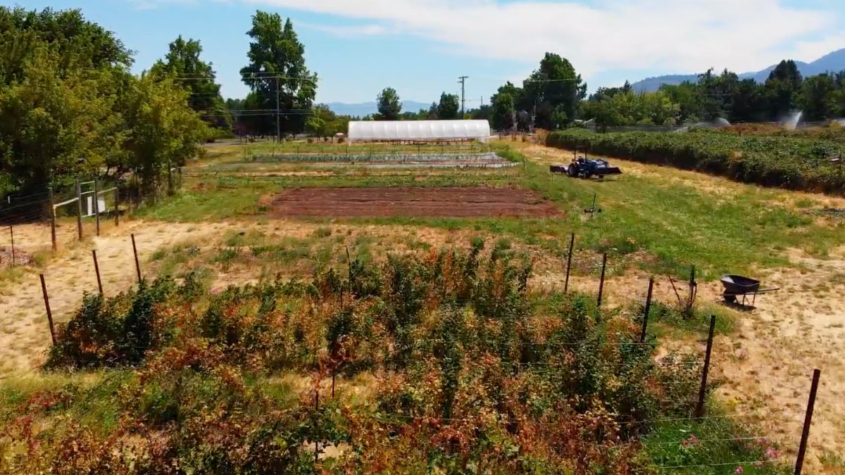
Wetlands are being restored at The Farm at SOU

SOU shows commitment to sustainability, restoring wetlands at The Farm

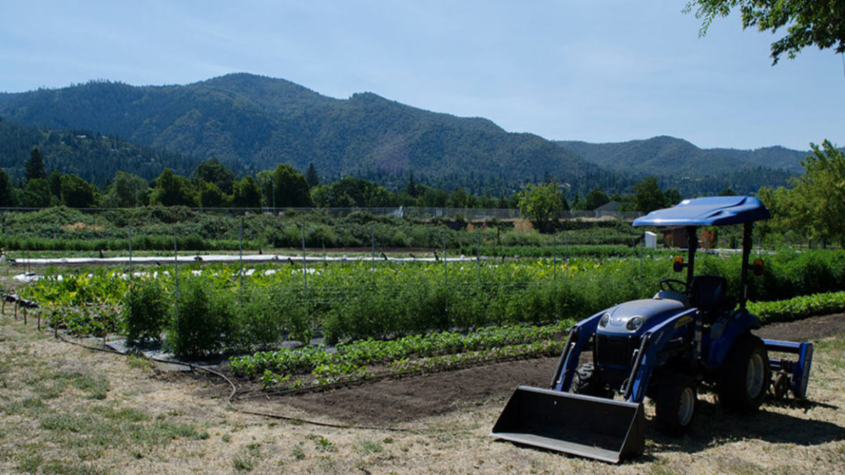
Southern Oregon University is demonstrating its commitment to sustainability and helping to preserve a portion of Oregon’s remaining wetlands with its ongoing effort to restore a “wet meadow” at The Farm at SOU.

“We have already noticed impacts from our work,” said associate professor Vincent Smith, director of The Farm. “The area is alive with the sounds of frogs and I personally watched a blue heron land in the site yesterday for a bit of rest.”

The wet meadow was previously overgrown with blackberries and other invasive species, but Smith and his team of 13 student workers have triggered a turnaround at the site. Much of the unwanted brush has been cleared and replaced with wetland plants that are native to the area, and a new boardwalk now extends into the meadow from the adjacent Thalden Pavilion.

“Much of the wetland walkway is now completed,” Smith said. “Students have planted over 100 new wetland plants and work weekly to reduce pressure from invasive species.

“One of the biggest challenges we have faced is the removal of invasive species, namely blackberry, without the use of chemicals.”

Funding for the restoration project has been provided by local philanthropists Barry and Kathryn Thalden of Ashland, whose earlier donation paid for construction of the pavilion that bears their name.

The wet meadow – part of a 5 ½-acre parcel that encompasses The Farm and the SOU Center for Sustainability – will become a hub for research and education when its restoration is complete. Students and community members will have opportunities to observe and research the beneficial ecosystem of a functioning wetland.

Wetlands – areas of land covered by fresh or salt water – used to cover 2.3 million acres of Oregon, and are home to numerous species of mammals, birds, fish and invertebrates. More than a million acres of the state’s wetlands have been lost to agricultural and urban development, leading to issues of water filtration, storm protection and flood control.

About 40 percent of Oregon’s wetlands have been drained, and 22 states have lost at least half of their wetlands.

The Farm’s restoration project has a long way to go – physical removal of invasive species will continue for several years.

“We will not see the full environmental impacts until later this year and next year,” Smith said. “Our construction will limit wildlife returning for now. I expect by late summer, we will begin to see extensive growth of native plants and hopefully begin to see additional wildlife on the site.”

Managing and maintaining the project has been a collective effort. The Farm has hosted seven work days, during which volunteers from SOU have contributed hundreds of hours to site preparation, planting and weeding. Two student interns in particular – Erin Wheeler, an Environmental Science and Policy major at SOU, and Katy Tarr, an intern from Chico State University – have made an impact as leaders of the restoration effort.

“Perhaps one of my favorite experiences during the restoration project so far was watching the two interns leading the project take pictures after planting was completed,” Smith said. “Watching students figure something out in the classroom is a beautiful thing … but watching students accomplish something outside of the classroom is why I come to work every day.”

The Farm, on Walker Street in Ashland, serves as a venue for organic agriculture and a source of healthy, sustainable food for the SOU community.

Story by Kennedy Cartwright, SOU Marketing and Communications assistant and student writer

Commencement week, virtually, at SOU

SOU offers various Commencement recognitions in lieu of ceremony

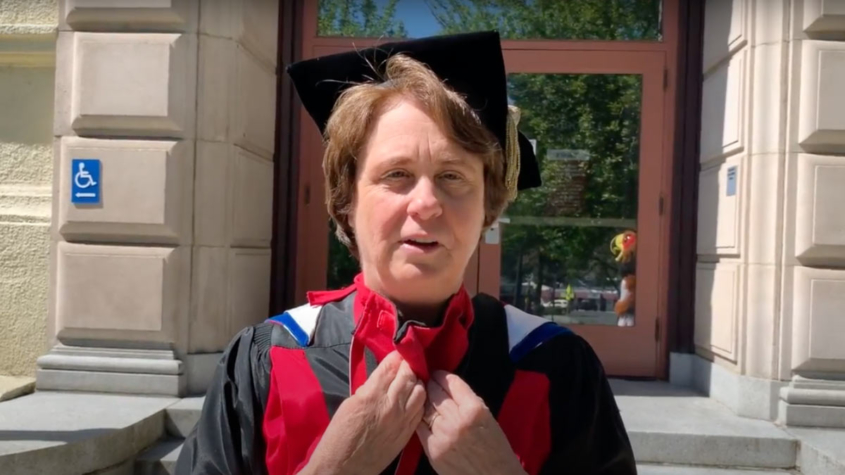
(Ashland, Ore.) — Raider Stadium will be strangely empty Saturday, when Southern Oregon University’s traditional Commencement Ceremony was planned until the COVID-19 pandemic temporarily ended all mass gatherings in Oregon. But SOU remains in celebration mode this week with a variety of displays and program-level virtual, video and drive-through acknowledgements.

And all 1,000-plus Class of 2020 graduates will be recognized with small, individualized signs placed in the campus lawn – after President Linda Schott and the Rocky Raider mascot congratulate each graduate by posing for a photo with their sign. The lawn sign photos will be posted on the university’s website Saturday as a slideshow tribute to the graduating class.

“College graduation is a remarkable milestone for any student,” President Schott said. “I commend this year’s graduates for their hard work and determination, and for the grace with which they have negotiated the challenges of these past few months. They have prepared themselves well for future success.”

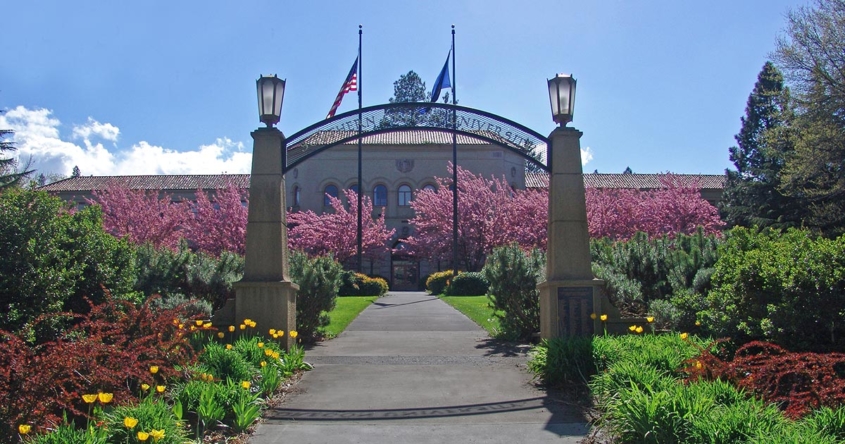
Visible displays to honor this year’s graduates will begin showing up on campus later this week, including a large Class of 2020 banner, signs at various campus locations and a commemorative display on the Churchill arch – traditionally a favorite spot along Siskiyou Boulevard for graduation photos.

At least 31 SOU programs are offering graduation observances specific to their graduates. Most of the program-specific events – which began last week and continue through this weekend – are virtual graduation celebrations. At least two programs are holding in-person but socially distant ceremonies, three created drive-through graduation events, four prepared video celebrations for their graduates and one – the Digital Cinema Program – streamed a live “Student Film Festival and Senior Celebration.”

SOU’s 2020 graduates have been told they should also expect to be invited back to campus for a full Commencement Ceremony at Raider Stadium as soon as an event of that size is allowed and the safety of participants and spectators can be assured.

-SOU-

Centralized trash cans and recycling bins will be the focus at SOU

Initiative to reduce trash cans – and trash – continues despite COVID-19

COVID-19 has reached so deeply into everyday life that it’s affected even seemingly unrelated procedures and initiatives – such as a project to reduce waste at SOU by eliminating individual trash cans.

The program – launched in January by sustainability and recycling manager Rebecca Walker – is continuing, but at a different trajectory and pace.

Walker, who became SOU’s sustainability and recycling manager in November, launched the initiative to remove individual trash cans from rooms across campus, starting with the Facilities, Management and Planning building.

“This is a small change, but to me a critical one,” Walker said. “Studies have shown that removing individual trash cans has a number of benefits, including the reduction in the use of plastic liners, helping staff and students to think about how they handle their trash, increasing recycling rates … and reducing overall trash.”

It will also save money by reducing the amount of time the custodial staff needs to take out the trash.

The Science Building, Taylor Hall, and Churchill Hall had their trash and recycling measured in early January, before the initiative started. The intent was to allow Walker and the rest of the Facilities, Management and Planning team to check the initiative’s outcome by comparing measurements later. Unfortunately, COVID-19 threw a wrench into that plan – the reduced presence of students and employees on campus would skew trash comparisons,.

“We haven’t done any trash measurements since January,” Walker said. “And with less people on campus and a campus operating differently, we are going to roll out this program of work over a longer period of time.” 

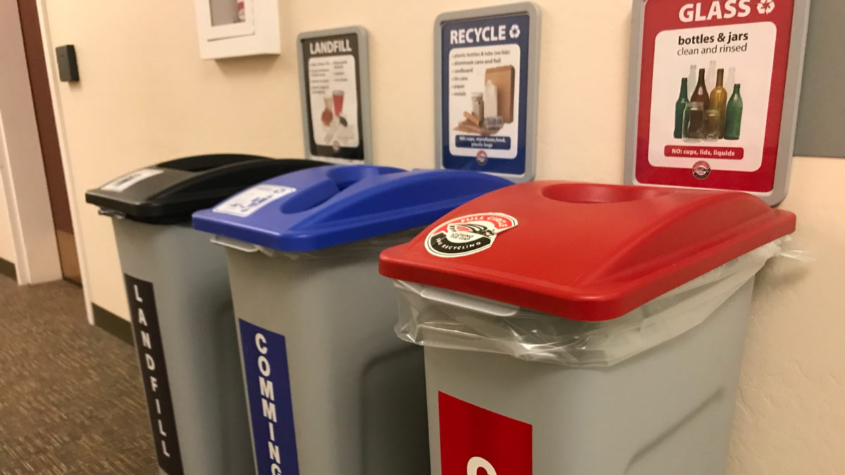
It’s only small, individual cans found in classrooms, offices and other locations that will be removed. The centralized waste stations (the ones containing three bins for trash, paper, and glass) will still be in every building, a short walk from most locations. And Walker is prepared to make exceptions in some situations.

“Not all individual trash cans had been removed,” she said. “In some cases, it makes sense to keep a smaller trash can between a few people or an individual trash can. We need to put in place systems that work for everyone, and in some cases there may be a reason why someone has to keep an individual trash can.”

The initiative has temporarily slowed, but it isn’t going away. 

“We do intend to continue to roll out (the trash can) project – including centralized locations, signage and education and awareness for recycling – over the summer,” Walker said. “Recycling is an important foundation for any campus to have in place to achieve its sustainability goals.”

In the meantime, she has refocused her team on projects that can be completed predominantly online – such as a new, more ambitious SOU Climate and Sustainability Plan.

“I have been working with the Sustainability Council and students to initiate (the development of a Climate and Sustainability Plan),” she said. “We have exciting plans of getting as many involved as we can through Zoom workshops and social media to maximize participation and involvement in the current, more online community.”

Those who want to be involved or have ideas for sustainability and climate action at SOU should complete the form at (https://form.jotform.com/200288565040148) by Friday, May 15.

Story by Blair Selph, SOU Marketing and Communications student writer

Restoration work at The Farm will happen Friday

Habitat restoration at The Farm at SOU to be completed – at safe distances

(Ashland, Ore.) — Southern Oregon University students and staff will make use of a charitable donation at one of the best places on campus for social distancing when they complete the restoration of a “wet meadow” area on Friday at The Farm at SOU.

The wetland was previously overgrown with blackberries and other invasive species, but has recently been cleared and a new boardwalk that originates at the Thalden Pavilion has been built into the area. About five student employees and interns will work with associate professor Vincent Smith, director of The Farm, to plant a variety of native plants beginning at about 3 p.m. on Friday.

“The plants are all native wetland plants and will be used exclusively to create habitat and as a tool for teaching about the value of wet meadows,” Smith said.

Funding for the restoration project was provided by local philanthropists Barry and Kathryn Thalden of Ashland. An earlier donation from the Thaldens paid for construction in 2018 of the adjacent pavilion that bears their name.

SOU is offering 98 percent of the courses that were originally scheduled for spring term – all by remote instruction or online platforms in response to the COVID-19 pandemic. All campus buildings are closed to the public, and students and employees have been urged to wear face masks and strictly observe safe social distancing.

But the 5 ½-acre property at The Farm offers a unique opportunity to get at least a handful of students outside and working on a project that supports the university’s commitment to sustainability. The Farm could have been shut down while the university is in remote operation, but doing so would have cost eight students the jobs they rely upon to help pay for school.

“The reason The Farm at SOU is still operating is because we can guarantee outdoor distanced work,” said Smith, chair of the university’s Environmental Science and Policy program. “The students have all received distancing training.”

The Farm, on Walker Street in Ashland, serves as a venue for organic agriculture and a source of healthy, sustainable food for the SOU community. It is also a center for sustainability and a hub for education, student and faculty research, and community outreach to the Rogue Valley.

-SOU-

Retired SOU registrar Mike Corcoran

Retired SOU registrar Mike Corcoran passes away

Retired Southern Oregon University registrar Michael Corcoran passed away in the early morning hours of Sunday, March 29, after a hard fought battle with cancer.

Mike was born in Florida on Sept. 19, 1944, but grew up in southern Massachusetts. He served in the U.S. Air Force during the Vietnam War as a “Ditty Bopper,” intercepting enemy code.

He was especially proud of his time at SOU, where he was hired in 1997 as associate director of information technology. He became registrar in 1999 and served in that position until his retirement in June 2007. Mike often talked about how he loved being registrar because it allowed him to work with and help students one-on-one.

Mike’s birthday was on the little-known holiday “Talk Like a Pirate Day,” and it was not uncommon for him to come to work dressed as a pirate on that day. He leaves behind a legacy of intellect and humor.

Mike is survived by his wife, Cindy Corcoran; children Ryan (Amber) Corcoran, Kelly Porter, Chris (Jennifer) Corcoran and Bobby Corcoran; and six grandchildren and one great-grandchild.

Mike donated annually to St. Jude Children’s Hospital, and contributions in his honor would be welcomed. He will be buried in the National Veterans Cemetery in Phoenix, Arizona, once the world is no longer in quarantine. He earned that privilege and will receive full military honors.

SOU operations modified for spring term

SOU goes remote for spring term, campus closed to public

(Ashland, Ore.) — Southern Oregon University has informed students and employees that all spring term courses will be delivered remotely and most on-campus operations will be limited to help slow the spread of the global COVID-19 pandemic.

SOU’s decisions came in response to an executive order today by Oregon Gov. Kate Brown for all public colleges and universities in the state to halt in-class coursework through at least April 28. University leaders made the decision to offer all classes remotely throughout spring term to give students, faculty and others a greater degree of certainty.

The university’s main campus in Ashland will be open only to SOU faculty, staff and students beginning Saturday.

President Linda Schott informed students of the developments today, and offered some details about how SOU’s COVID-19 responses will affect winter and spring term grades, financial aid, spring courses, academic support programs, student employment, residence hall occupants and other campus programs or operations. The university will waive interest on all student accounts, late payment fees and revolving charge fees for all of spring term.

SOU’s tuition rate is set for the entire academic year, but the university’s Board of Trustees will discuss modifications to a variety of student fees – including those for the Student Recreation Center, Student Health & Wellness Center, Student Life activities and remote delivery of courses – during an emergency meeting tonight.

SOU employees were notified this afternoon that most will be encouraged work remotely until further notice, and those who remain on campus will be required to follow social distancing guidelines. Exceptions to the telecommuting arrangement include those whose work is designated as “essential,” whose work cannot be performed away from campus, whose presence on campus is required for operational purposes or who need technical or other resources that are not available at their remote locations.

Academic counseling and guidance will continue throughout the term – largely online – and faculty members will be told whether their presence on campus is needed.

SOU’s new measures are consistent with those adopted by most of Oregon’s six other public universities in response to the governor’s executive order.

The order prohibits colleges and universities “from conducting in-person classroom laboratory and other instruction” from this Saturday through April 28, with the possibility that the period will be extended. Gov. Brown also ordered higher education institutions to “limit on-campus operations only to critical functions and … employ strict social distancing measures for all on-campus employees and residents.”

The governor specifically allowed the continued operation of programs including student housing and dining services. SOU’s residence halls will remain open for spring break throughout spring term, and food service will continue to be available at the Hawk dining commons – but only by takeout.

-SOU-

SOU takes action against COVID-19

SOU takes steps to protect campus, slow COVID-19 spread

Southern Oregon University continues to both anticipate and react to challenges in the global COVID-19 outbreak, implementing a variety of new measures this week to protect the health and well-being of the campus community and enable continuity in academic and student support programs.

The SOU campus remains open and active even as students, faculty and staff adapt to measures that will reduce their risk of contracting the virus. Information and resources to help campus community members navigate the outbreak are available on the university’s COVID-19 website (sou.edu/campus/notifications/).

SOU President Linda Schott announced the newest steps on Thursday to prepare for and mitigate the effects of COVID-19. The measures include plans for finals week, spring break, spring term coursework, remote working, personal and SOU-related travel, groups and gatherings, and international programs.

The new actions are consistent with those announced for other public universities in the state and are based on guidance from Oregon Gov. Kate Brown, the Oregon Health Authority and the Higher Education Coordinating Commission.

Finals week
President Schott said that finals will proceed as scheduled. The university is making remote options available to faculty members to use, if feasible. If remote exams are not practical, faculty members have been directed to ensure that social distancing criteria are met – a distance of at least three feet should be maintained between all people.

SOU Provost Susan Walsh followed up with an email to faculty members Thursday night, asking them to make determinations on their final exams and register them today on a shared spreadsheet.

Spring break
The university is extending this year’s spring break for students by one week – it will begin on Monday, March 23, and spring term classes will begin on Monday, April 6. SOU’s intent is to allow additional time for the curve of the virus’s spread to “flatten” and also to give faculty members an opportunity to plan and develop options for spring term remote course delivery.

Residence halls at SOU and the Hawk dining commons will remain open through spring break for students who choose to remain on campus.

Spring term
Both the president and provost asked faculty members to prepare for remote delivery of instruction in all courses where it’s feasible. Remote instruction – which includes online, video conferencing and other methods – is intended to help limit opportunities for virus transmission in group settings.

The new start date for spring term will still enable all courses to be completed in time for SOU’s commencement on Saturday, June 13.

Remote work
All supervisors and managers were asked to offer remote working opportunities to office employees, in all cases where those arrangements are feasible. Allowing work to be done away from campus is another effort to limit chances for the virus to spread within SOU’s campus community.

Travel
Limits have been placed on all non-essential SOU-related travel. Members of the campus community were also encouraged to avoid personal travel outside of southern Oregon to help slow the spread of COVID-19.

Groups and gatherings
The president announced the cancellation of all non-essential SOU activities, events and gatherings that do not allow participants or attendees to maintain a distance of three feet from each other. This cancellations include audience admission at intercollegiate athletics and activities, except for student participants, essential personnel and credentialed media. The NAIA has cancelled all currently scheduled events, and SOU is awaiting word on whether all spring sports seasons will be cancelled or resumed after a delay.

All performance and museum events that result in gatherings of 20 or more people have been postponed until further notice by the Oregon Center for the Arts at Southern Oregon University. The decision was made to protect audiences, students and employees from the spreading virus.

The university is also encouraging the use of remote meetings whenever possible, and has placed a limit of 20 people or fewer on all non-essential meetings. Organizers have been directed to arrange spaces that can accommodate three times the number of invited attendees, to allow adequate room for social distancing, when in-person meetings are necessary.

International programs
All SOU-sponsored international programs and trips have been suspended until further notice.

low tuition rate increase approved

Study confirms SOU’s vital economic impact role in region

(Ashland, Ore.) — Southern Oregon University is a powerful economic engine for its region, responsible for a total of $282.5 million in annual output in Jackson County, according to a recent economic impact study by Portland-based consulting firm ECONorthwest.

SOU also is responsible for a total of 2,146 direct, indirect and induced jobs in its home county, the study found. Direct jobs are those at the university, indirect jobs are at businesses with which the university contracts and induced jobs are those generated in the local economy when wages earned at the university are spent.

The ECONorthwest study looked at the impact of all four Technical and Regional Universities (TRUs) in Oregon – SOU, Oregon Institute of Technology, Western Oregon and Eastern Oregon. SOU rated highest in both total economic output and total jobs among the four universities.

“This study confirms what we have long known – that SOU is a critically important player in the southern Oregon economy,” SOU President Linda Schott said.

“Our impacts go well beyond what was measured in this study,” she said. “We work collaboratively with employers in our region to develop academic programs that fill local needs and create opportunities for our students. We confer about 1,100 degrees each year, and a high number of those graduates stay in our area to launch careers and become leaders in their fields.”

The economic impact study also pointed to a recent analysis by the Oregon Employment Department that found a significant earnings advantage for local workers with four-year college degrees. The Employment Department determined that Jackson County residents with bachelor’s degrees earned an average of 35.5 percent more per month than those with some college or an associate degree, and 48.7 percent more than those with only a high school education.

The ECONorthwest study found that the TRU institutions had an annual total of 188,053 out-of-town visitors on their campuses, who spent a combined $15.4 million in those communities – with SOU the highest, at $6.05 million. Spending was calculated for lodging, dining and shopping.

Overall, the study found that the four TRUs were responsible for $1.03 billion in direct, indirect and induced economic output in Oregon.

-SOU-

SOU's Lock-In event for criminology students is Friday

19th annual “Lock-In” brings police to teach at SOU

SOU’s Criminology and Criminal Justice students will get plenty of hands-on training when representatives from a variety of local law enforcement agencies will be on campus to present workshops at a “Lock-In” event on Friday (Feb. 28).

The 19th annual Lock-In will draw on the expertise of agencies including the Ashland and Medford police departments, Oregon State Police, Jackson County Sheriff’s Office, Jackson County District Attorney’s Office and the Army National Guard. They will be on campus to raise awareness on criminal justice issues and host a variety of learning scenarios, which will run from 1 to 3:30 p.m. and from 3:35 to 6 p.m.

A large police presence will be visible primarily in and around Taylor Hall and the Stevenson Union. Sessions will be held in the Rogue River Room, where officers will present workshops on topics such as gunshot and traumatic injury control, active shooter scenarios, K9 demonstrations, crime scene investigations, explosives units and more.

Simulation notices will be posted on the buildings, along the perimeter of the area and in each room where a simulation is held.

The Lock-In provides opportunities for networking and camaraderie, along with practical training. To sign up students can pay a $10 fee or can get 1 credit by enrolling in the 1/2 day class CCJ 199.

Those with additional questions may contact criminology professor Tiffany L Morey.

Story by Blair Selph, SOU Marketing and Communications student writer
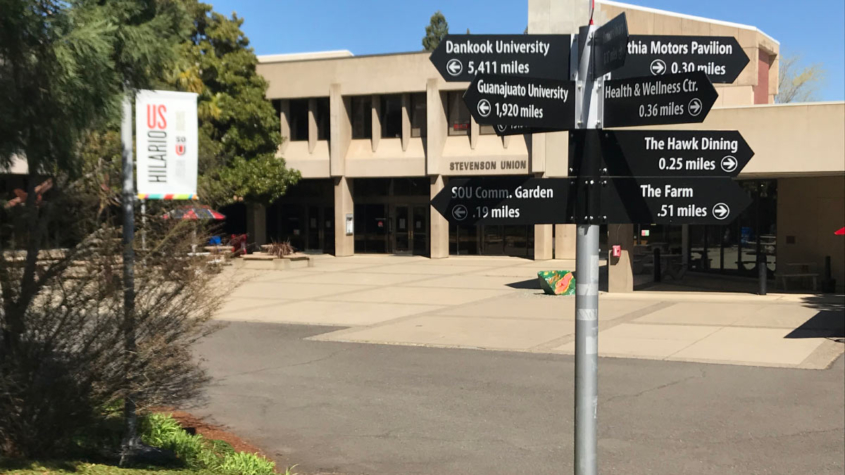
The Governor's Food Drive at SOU will help students with unreliable access to food

Governor’s State Employee Food Drive to run through February at SOU

All food and cash donations collected at SOU during the seventh annual Governor’s State Employee Food Drive – which runs through February – will go to the Student Food Pantry and SOU students with unreliable access to food. Payroll deductions will support food assistance programs at ACCESS – the region’s community action agency.

“The most needed items at the SOU food pantry include boxed meals, soups, oatmeal, peanut butter, canned tuna, tortillas, canned fruit and other non-perishable items,” said Jill Smedstad, the environmental and community engagement coordinator for Student Life.

Recent studies have shown that as many as half of all U.S. college students have unreliable access to nutritious food. The Food Pantry provides SOU students who are in need with as many as 10 items of nonperishable food or hygiene supplies each week. Donations through the Governor’s Food Drive go directly toward supporting the Food Pantry.

“Overall, the total pounds collected (last year), including the pounds equivalent to the monetary donations, was 10,697,” Smedstad said. “This is equal to about 8,000 meals. This year we are hoping to increase both pounds of food donated and monetary donations through employee payroll deductions, with a goal of raising the equivalent of 10,000 meals.”

Red collection bags are expected to be delivered soon by campus mail to all SOU employees for the food collection competition among campus buildings, which is coordinated by the Student Sustainability Center. The bags can be filled with non-perishable food items and returned anytime this month to collection barrels located in each building. Employees may also sign up for monthly or one-time payroll deductions and submit the form to Michele Barlow in Human Resources.

Those who donate will help students in need and also have a chance to win awards and prizes for their good deeds. SOU Dining will offer a prize of coffee and snacks to employees from the building that collects the most pounds of donated food, with a dollar considered the equivalent of four pounds. All employees who sign up for payroll deductions will also be entered into a drawing for various prizes.

Other events associated with the food drive include a free concert, featuring student and faculty musical groups, presented by SOU’s Oregon Center for the Arts. Admission to the “Feed Body and Soul” concert – at 7:30 p.m. on Tuesday, Feb. 11, in the Music Recital Hall – will be two cans of food or a cash donation at the door. Performing artists include Left Edge Percussion, SOU Jazz Combo, SOU Chamber Choir, and Mazama Saxophone Quartet.

SOU Athletics will collect nonperishable food donations at the women’s wrestling match on Feb. 20, and at the mens and womens basketball games on Feb. 21.

“While the Governor’s State Employee Food Drive is focused specifically on soliciting donations from employees, students who can are certainly encouraged to donate as well – at athletic games, at the ‘Feed Body and Soul Concert’, or by putting cans in any of the barrels around campus,” Smedstad said.

The Student Sustainability Center will host a day of service with ACCESS at its food warehouse in Medford, from 9 a.m. to 2 p.m. on Saturday, Feb. 29. The entire SOU community is invited – students, employees, alumni, and friends and family. Transportation to and from Medford will be offered, and lunch will be provided. Sign up or find more information about the event online at tinyurl.com/SOUvolunteer2020 after Feb. 1.

Story by Blair Selph, SOU Marketing and Communications student writer