SOU Ashland Vitality Plan addresses long-term sustainability

SOU finalizes Vitality Plan for institutional transformation

(Ashland, Ore.) — Southern Oregon University has released the final version of its Vitality Plan, a strategic outline that addresses financial challenges and prepares the university for long-term sustainability and student opportunities.

The final version includes a variety of modifications based on suggestions from faculty, staff and students that were submitted after a provisional version of the Vitality Plan was announced June 15.

The new version holds firm to the university’s objective of at least $20 million in overall budget savings – through combined SOU Resiliency and SOU Vitality Plan efforts – in the fiscal year that ends next June 30, but does so while maintaining all but one of its current academic offerings. The plan calls for a sunset of the Music Industry and Production degree but will maintain the overall Music program, which is possible by committing the institution to a revolutionary change in course delivery and design.

“The Vitality Plan was constructed in such a way as to keep as many pathways as possible open to students,” SOU President Rick Bailey said in a message to campus Tuesday night. “We’ve done just that. But we still need a robust student body to thrive, and we’ll need all of us working together to keep students on the path toward the graduation stage and the fulfillment of their educational goals.”

The final version of the plan was released at the conclusion of a deliberation period that was required by the university’s contract with its faculty union, the Associated Professors of Southern Oregon University, and consultation with the Service Employees International Union. It is a revision of the initial plan that was drafted following months of analysis, discussion and engagement with students, faculty, staff, alumni and community stakeholders. Those interactions led to important improvements that will serve the institution and the community during the implementation process and beyond.

The plan prioritizes reducing impacts on students wherever possible, preserving pathways to degree completion and strengthening SOU’s long-term financial and operational foundation.

“Our new proposed mission centers on educating students for resilient, meaningful lives by making the Rogue Valley our classroom, mentorship our method and practical, experiential work our curriculum,” an introduction to the plan says. “Moving away from the outdated model of a generic regional institution, the Vitality Plan adopts a ‘Living Laboratory’ operating system that unifies the university’s academic offerings and prioritizes the cultivation of essential human capacities that no machine can replicate.”

The Vitality Plan is intended to connect SOU to the communities it serves through a bioregional approach; provide streamlined pathways to degree completion in every academic discipline; offer flexible options for students through innovative, interdisciplinary academic design models; and incorporate a human-connected approach to education that is cognizant of the rapid pace of emerging technologies.

The final version of the Vitality Plan will result in the elimination of a total of 60.6 faculty and staff positions over the coming year. That is about five fewer than those identified in the provisional version of the plan, but the overall expected savings for the year of $20,028,030 remains above the $20 million threshold set by the university’s Board of Trustees.

President Bailey acknowledged in Tuesday night’s campus message that all reductions in the plan will be difficult and come at a human price.

“Our goal during this process is to respect the dignity of all our employees and their contributions to our students and our university,” he said.

You can review the full Vitality Plan, revisions and more here.

-SOU-

Economic impact of SOU Ashland

Economic impact report sees SOU as key resource

(Ashland, Ore.) — A new economic impact study that measures the financial reach of Oregon’s three regional public universities shows that Southern Oregon University has a prominent and growing influence on the prosperity of Jackson County and the Rogue Valley.

SOU’s total annual economic impact is $730 million statewide, $532.5 million in southern Oregon and $440.1 million in Jackson County alone, according to the study. The most recent previous economic study of SOU, in 2019, found a total impact of $282.5 million in Jackson County but did not measure regional or statewide impact.

The new study shows that the state of Oregon receives a 24X return on its investment in SOU – the university’s economic impact of $730 million is more than 24 times the $30.4 million that is appropriated to SOU for operational expenses by the Oregon Legislature.

“It’s no surprise to us that SOU is a critically important economic prosperity engine for southern Oregon,” SOU President Rick Bailey said. “This study backs up what we already knew and provides a lot of important detail about the scope of that influence and why it is essential that we protect the university’s ability to stimulate economic growth on the local, regional and statewide levels.”

The study, “The Economic Impact of the Regional Public Universities of Oregon,” was conducted this spring by Econsult Solutions, Inc. – a Philadelphia consultancy that specializes in economic, planning and public policy research. It measures and quantifies the economic impacts of SOU, Eastern Oregon University and Western Oregon University – which jointly commissioned the study and together have a total statewide impact of $1.9 billion.

The regional universities support about 10,900 jobs in Oregon, have a combined 78,038 alumni living and working in the state and produce much of the workforce for the largely rural areas they serve – from teachers and healthcare professionals to business leaders, law enforcement officers, counselors, tourism employees and creative industries workers.

“Oregon’s regional public universities drive the economies of our communities, and much more,” SOU’s President Bailey said. “We are sources of knowledge, launching points for innovation, and centers for cultural exploration and expression. We provide leadership and creativity, enabling our regions to be productive and competitive in a quickly evolving and highly dynamic environment.”

SOU by itself supports a total of 4,060 direct, indirect and induced jobs statewide, for a total of $202.4 million in annual earnings. Direct jobs are those of the university’s employees and vendors, while indirect jobs are those related to subsequent business-to-business transactions. Induced jobs are those supported by the ripple effect of spending by direct and indirect employees.

The economic impact study found that SOU:

  • Serves a total of 7,212 students annually, including full-time, part-time, dual-credit and lifelong learners;
  • Has a total of more than 675 employees, including student workers;
  • Has 26,165 alumni living in Oregon, including 18,473 in the workforce who earn an aggregate annual wage premium of $362.6 million – the amount in additional wages they earn due to their university degrees;
  • Has an average of 24,042 campus visitors each year, with student and visitor spending accounting for $108.5 million in annual spending in Jackson County and $157.9 million in southern Oregon;
  • Produces capital construction projects that account for about $17.1 million per year in total economic impact and support about 80 full-time jobs;
  • Supports local, regional and statewide employers with bachelor’s degree earners, about 68% of whom remain to work in Oregon for at least a year after graduation.

Overall, the study found that 74% of freshman students at the three regional public universities come from within Oregon and that 65% of graduates are still working in Oregon a decade after graduation.

-SOU-

SOU Ashland offers respite from wildfire smoke

SOU offers respite from wildfire smoke

(Ashland, Ore.) — The Southern Oregon University Student Recreation Center continues to be a resource for both SOU employees and community members seeking a refuge from wildfire smoke and unhealthy outdoor air quality. The SRC offers free admission to its elevated, indoor walking and running track – a popular, smoke-free haven – from 5 to 7 p.m. Monday through Friday, whenever Ashland’s air quality is at unhealthy levels (101+AQI).

Photo ID and a signed waiver will be required at check-in.

The SRC features high-efficiency air filtration and air conditioning systems, and is a good option for walking, jogging or visiting with others after work.

SOU has made its Student Recreation Center available as a community resource during local wildfire smoke events over the past seven years. Community members who want full access to the SRC during regular operating hours can purchase day passes onsite. More information on SRC passes and memberships at recreation.sou.edu/memberships.

The SRC will be closed for annual maintenance from Saturday, Sept. 5 until the start of the fall term.

-SOU-

SOU Computer Science capstone students

Capstone students build energy dashboard

Southern Oregon University buildings use thousands of kilowatt-hours of electricity each day to power classrooms, residence halls, offices, laboratories, lighting, and heating and cooling systems. While electricity meters across campus collect detailed information about energy usage, the information was not easily accessible until group of Computer Science students changed that with their senior capstone project.

The team developed the SOU Energy Dashboard, a custom interactive web application created for SOU’s Sustainability Office. The dashboard gathers electricity data from across campus and puts it into a single platform where students, faculty and staff can view building energy use and compare performance across campus.
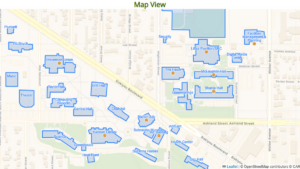
SOU Computer Science energy dashboard map“The dashboard was designed to transform raw energy data into actionable information,” said Becs Walker, SOU sustainability director and the dashboard project’s client. “By making electricity use more visible and accessible, the dashboard can help the university identify opportunities to reduce utility costs, improve energy efficiency, lower carbon emissions and support long-term sustainability planning.”

The project also supports SOU’s Living Laboratory approach, where students apply classroom knowledge to challenges that face the campus and surrounding community. In this case, the capstone team created a tool that is both valuable to the university and creates new opportunities for teaching and experiential learning. The data can be incorporated into future coursework and student projects, as well as future sustainability initiatives.

For student David Trujillo, the project connected closely to a personal interest in sustainability.

“I have always felt that energy efficiency is something that should be a higher priority, and I thought it would be a great opportunity to make something that could have a positive impact,” he said.

Luke Wulf was drawn to the technical side of the project, especially the opportunity to work with databases and data visualization.

“I really enjoy working on storing data in databases, and this project interested me due to that reason,” Wulf said. “I thought storing information and needing to display it in a way for anyone was also a fantastic goal, and should be something we already had.”

The dashboard includes visual tools such as charts and a campus map page, which helps users interpret the information that previously existed mainly as numbers in spreadsheets. For Trujillo, the charts stood out because they addressed one of the main challenges that the Sustainability Office faced.

“(The charts) are a powerful tool that solves one of the core problems Sustainability was facing with all the data just being numbers in spreadsheets,” he said. “It was difficult and time consuming to derive meaning from the data, but now it can be understood at a glance.”

Griffin Greimes focused on the Electricity Dashboard map page, which was designed to be understandable and useful to anyone interested in learning more about the electricity usage across campus.

“I think I am most proud of the work that I’ve done on the Electricity Dashboard Map page,” Greimes said. “Making an easily accessible and understandable page that anyone is able to engage with, that looks good and is immediately useful to anyone interested in learning more about the electricity usage, is something that can always use additions and improvements.”

Behind the scenes, the project also included important software development infrastructure. Student Cory Short’s work included the team’s Continuous Integration and Continuous Deployment pipeline, which automates website updates whenever approved changes are made to the codebase.

The group also worked closely with SOU Information Technology, giving the students experience that felt much closer to professional software development than a traditional class assignment. Wulf said that process taught him how software development works in the real world.

“(With) our work with IT as a third-party developer, our work was treated like a real thing, given tasks we had to complete to meet our goal,” he said. “This process made all of us learn how it will be like in the real world, where not everything can be updated with just some light persuasion, but instead, long hard hours of working on code.”

Short had a similar takeaway.

“I learned a lot about how a project can be run and a lot about GitHub infrastructure and cloud infrastructure,” he said. “The whole project ended up feeling a lot like it was closer to a job than a class we were doing for a grade.”

Trujillo said the capstone project also gave him practical experience with the tools and processes used in industry.

“I really appreciate the insight gained from sprints, client and manager meetings, getting hands-on experience in GitHub, and all the other things I learned that will be applicable to working in the industry,” he said.

One of the biggest challenges came late in the process, when the team had to address ADA accessibility requirements. The requirement was introduced about a month before the end of the term, and the group had to work quickly to meet all 50 requirements in about two weeks.

When asked about the project’s obstacles, the team had a clear, collective answer:

“Absolutely ADA. It was a requirement given to us only about a month before the end of term, and we had to work through it extremely quickly. We managed to get through all 50 requirements in just two weeks, although we accidentally used the entire budget for GitHub Actions for the month by doing it.”

Despite this challenge, the team successfully brought the project to a point where it could function as an official university tool and website. For Wulf, one of the most exciting moments was getting the dashboard connected to its own SOU subdomain.

“When we started this, we had no idea we would have our own subdomain on the sou.edu pages,” he said. “But this term, we’ve done a huge amount of work on making it happen, and finally getting that up was easily the proudest I’ve been in this whole project. I think I’ve told everyone in my life about it at least a few times.”

The dashboard may also create opportunities for future student work. Because the energy data is now easier to understand and access, it could be used in various ways such as coursework, research or future capstone projects.

“Part of the point of this project was to build a way for people to view energy usage at SOU, using it to analyze and compare,” the team said. “Along with that, our client was excited about the idea of students possibly using it for capstones, now that the data is easily accessible.”

For the recent capstone students, completing the dashboard marked both the end of their undergraduate Computer Science experience and the beginning of something that may continue to serve the university for years to come.

“It feels fantastic to have a finished product that has been put to such official use by the school,” Wulf said. “I’m so proud to have something that I know people will use, as well as something I’m happy and excited to show to others.”

Trujillo said the experience felt like a climax of the CS program.

“It really feels like the culmination of everything we have learned across CS, where we get to finally put everything we learned together to build something real and tangible,” he said. “It’s been extremely satisfying.”

For Short, the most rewarding part is seeing six months of work become something real.

“It feels quite satisfying to see what we built over six months actually function and exist now,” he said. “And hopefully we can look back to see it still running in several years from now.”

The team also sees many possibilities for the dashboard’s future. With more time, they would have liked to add filtering options to the map page, which would allow users to view specific categories of buildings, such as classrooms. They also hoped to eventually incorporate live data readings, though that would require a larger-scale project with additional IT support.

“Part of the point of this project was to build a way for people to view energy usage at SOU, using it to analyze and compare,” the team said. “Along with that, our client was excited about the idea of students possibly using it for capstones, now that the data is easily accessible.”

Story by Felicity Johnson, SOU Computer Science Major

SOU Ashland archaeology artifact transfer

Cultural items transferred from SOULA to Tribe

Members of the Coquille Indian Tribe met with SOU representatives on June 16 to commemorate the historic transfer of 11 archaeological collections to the Tribe’s new Me’-dn Mv-ne’ Curation Facility in Coos Bay, which was recently approved to serve as a regional repository for archaeological collections.

SOU Ashland archaeology artifact transferThe collections resulted from several collaborative archaeological excavations going back nearly 30 years between the SOU Laboratory of Anthropology (SOULA) and the Tribe. The excavated cultural items have been securely housed at SOULA’s on-campus curation facility, which carefully stores thousands of archaeological objects from around the state. Coquille Tribal members and staff can now care for the items at their new curation facility.
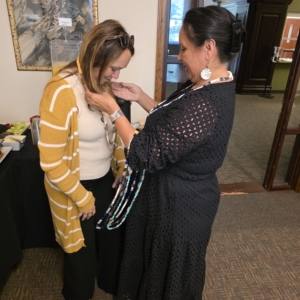
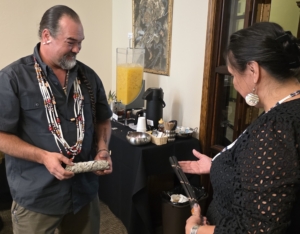
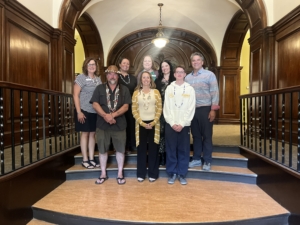
“We were grateful for the opportunity to celebrate this milestone with Chief Justin Futch, Bridgett Wheeler and the Tribal members that participated in the transfer, and look forward to continuing building opportunities for collaboration and support,” said Chelsea Rose, director of the SOU Laboratory of Anthropology.

SOULA bills itself as “an on-campus archaeological firm” that conducts grant- and contract-funded research in partnership with private, local, state, federal and Tribal organizations. Students in various majors connect with SOULA to learn through fieldwork, laboratory analysis, conference presentations, writing and more – at excavation sites as well as SOULA’s on-campus laboratory and curation facility.

SOU Ashland archaeology artifact transfer SOU Ashland archaeology artifact transfer SOU Ashland archaeology artifact transfer

SOU Ashland wildlife photo

Funding for I-5 wildlife crossing gets green light

(Ashland, Ore.) — Good news arrived recently for Southern Oregon University researchers and others who have done preliminary work in the development of a wildlife crossing over Interstate 5 south of Ashland, when the Federal Highway Administration released key funding for the overpass.

Oregon was awarded a federal Wildlife Crossing Pilot Program (WCPP) grant of $33.2 million for the project in December 2024, but ODOT’s use of the  funding was only recently finalized after many months of negotiation. Oregon senators Jeff Merkley and Ron Wyden pressed to fulfill the grant, which will be matched with $3.8 million from the Oregon Department of Transportation for a total project cost of $37 million.

SOU Ashland wildlife photo“This is a win not only for wildlife and driver safety, but also for the educational opportunities it will provide to Southern Oregon University students,” said Karen Mager, an associate professor in SOU’s Environmental Science and Policy program.

“SOU has been studying wildlife along I-5 for four years now to assist in planning this overpass,” Mager said. “We thank Senator Merkley and Senator Wyden for their work to secure this funding. We at SOU look forward to continuing our research to document the animals that use this wildlife overpass and share that information with the public.”

The Mariposa Wildlife Crossing – the first wildlife overpass anywhere on I-5, from Mexico to Canada – will span the freeway’s northbound and southbound lanes 1.7 miles north of the Oregon-California state line. Planning and construction of the overpass, directional fencing to funnel wildlife to the overpass and associated habitat improvements are expected to be completed no later than spring of 2029.

“This project will be instrumental in safeguarding all the special species that call the Cascade-Siskiyou National Monument home and protecting drivers from dangerous wildlife collisions,” said Senator Merkley, a senior member of the Senate Environment and Public Works Committee, where the budget request was recent reviewed.

“I’ll continue to champion smart federal investments that protect families, our natural treasures and the diverse wildlife that call them home,” Merkley said.

The Oregon Department of Transportation has been collaborating on the project with the Southern Oregon Wildlife Crossing Coalition. A vision for the wildlife crossing grew out of a February 2021 meeting of representatives from 17 organizations and agencies, including SOU, that are part of the coalition.

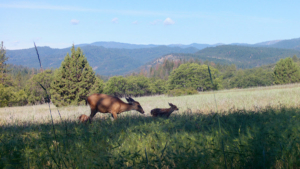
Mager and students in her SOU classes and paid research internships have used camera traps to study wildlife use of I-5, to better understand regional needs for wildlife crossings. Those camera traps have taken more than a million photos and videos – most triggered by wind – and SOU Computer Science and Environmental Science and Policy students have used AI to sift through the data, identifying and capturing more than 20,000 unique animal images.

The SOU-generated data was a key component in the feasibility study that identified the priority site for an overpass. The university’s monitoring efforts – and opportunities for research funding – are expected to continue for at least the next six to seven years, Mager said.

About 6,000 vehicle-wildlife collisions are reported each year throughout Oregon, according to state agencies. Data from six wildlife underpasses in Oregon – five under Highway 97 and one under Highway 20 – show that their construction led to an 86% decrease in wildlife-vehicle collisions in the areas near those underpasses.

The site of the I-5 overpass is considered to be the highest-priority location along I-5, due to its biodiversity and sensitive wildlife populations. The region is home to rare mammals such as the Pacific fisher, along with deer, bear, elk, cougars and other large-bodied animals – all of which have been observed at the site of the future overpass. Many rare and unique butterflies and other species are also found in the area.

-SOU-