Friday Science Seminar-Paddock-Alzheimer's

Friday Science Seminar: SOU alumna and faculty member on Alzheimer’s

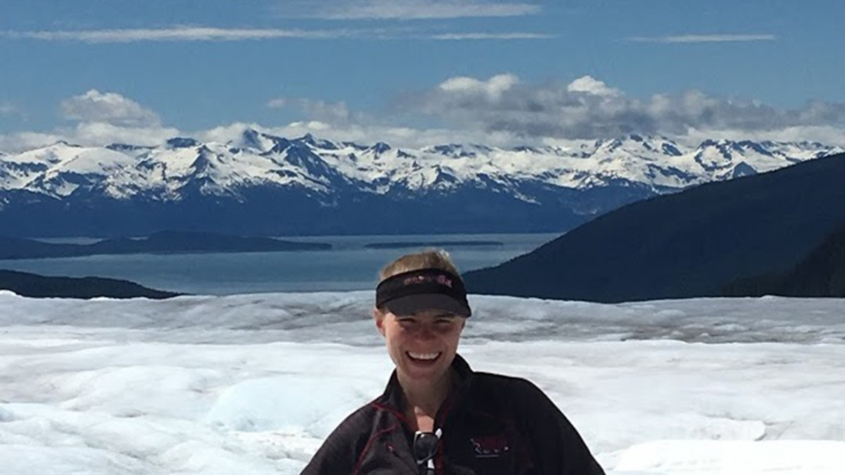
Brie Paddock, an SOU alumna and assistant professor in the university’s Biology Department, will discuss the role of metals in Alzheimer’s disease during a Friday Science Seminar on Friday, Feb. 22.

Paddock’s lecture will be in the Science Building Auditorium (Room 151) from 3:30 to 5 p.m. The lecture is free and refreshments will be provided by SOU’s STEM Division.

Alzheimer’s Disease afflicts 5.3 million Americans, has few current treatments and no known cure. The progressive, neuro-degenerative disease involves multiple factors – including genetic and environmental – and is characterized by abnormal plaque deposits and “tangles” in the brain, which disrupt communication between synapses  and lead to losses in memory function.

Paddock’s talk will focus on current research on the amyloid hypothesis of Alzheimer’s, including the role of metals in the disease’s progression.  A small percentage of cases are caused by a single gene, including rare mutations in Amyloid Precursor Protein and associated proteins.

Paddock joined SOU’s Biology Department in 2018, and teaches courses in animal physiology and principles of biology. Her background also includes molecular biology, immunohistochemistry and human physiology.

Her research centers on synaptic function using the fruit fly (Drosophila) model. Paddock helped develop a fruit fly model of Alzheimer’s disease, and uses the model to test the role of oxidative stress and environmental factors in the disease’s development, particularly in memory function and synaptic structure.

Her previous work included a determination of the molecular mechanism of calcium-dependent exocytosis at the synapse, a key event in cell-to-cell communication in the nervous system.

SOU’s Friday Science Seminar program offers presentations each week on topics ranging from biology to computer science to chemistry.

Ashland Chamber board-several members not pictured

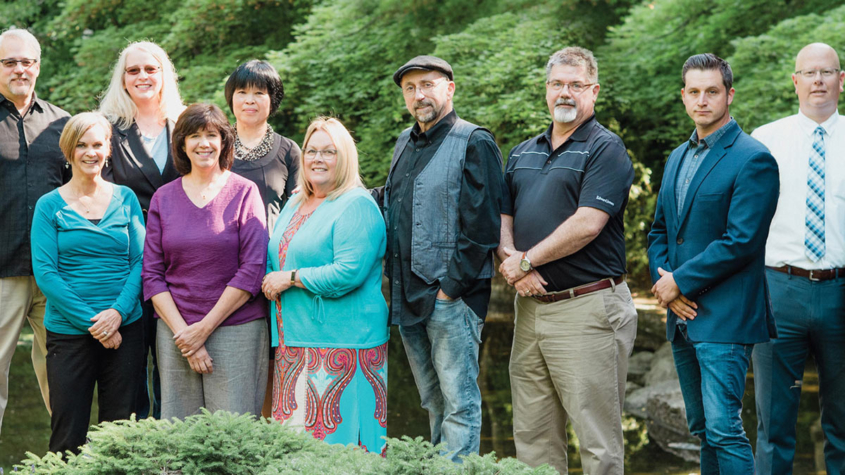
Ashland Chamber goes to bat for SOU

(Ashland, Ore.) — The Ashland Chamber of Commerce acknowledged an integral relationship between the business community and Southern Oregon University when the chamber’s Board of Directors voted unanimously today to urge adequate state funding for SOU.

Board members approved a letter of support that asks Governor Kate Brown and members of the Oregon Legislature for funding sufficient to maintain current service levels at Oregon’s seven public universities and keep tuition increases at manageable levels. The resolution explains the crucial role of higher education in preparing a qualified workforce to drive the region’s economy.

“The Ashland Chamber of Commerce, currently representing over seven hundred businesses and organizations, has been deeply connected, supportive and involved as a strong community partner of Southern Oregon University for over a century,” said a first draft of the letter that was provided following the meeting by Sandra Slattery, the Chamber’s executive director.

The letter pointed out that SOU is Ashland’s largest employer, its faculty help to educate future business and community leaders, and decreased state funding will ultimately lead to a loss in state revenue as fewer students enroll, graduate and land well-paying jobs. The Chamber “encourages legislative financial support for the future of Oregon through increased funding for higher education,” the letter said.

SOU President Linda Schott was invited to address the Chamber of Commerce board, and said after the meeting that the group’s endorsement will be helpful in ongoing conversations with lawmakers.

“It is very encouraging for us to get this kind of support from Ashland’s business leaders,” the president said. “It recognizes that SOU is truly part our community’s fabric, and that our university plays a crucial role in the region’s economic well-being.”

Governor Brown has included $736.9 million per year for the public universities in her recommended budget – the same amount that was approved for the current biennium, which ends June 30. But funding at that level doesn’t account for increased costs to the universities that are beyond their control – including the PERS retirement system, employee health plans and statewide collective bargaining agreements.

The universities need $857 million in funding from the state to maintain current academic and student support programs, and to keep annual tuition increases at or below 5 percent.

As recently as 1990, state support for higher education in Oregon accounted for more than two-thirds of attendance costs and tuition covered most of the remainder. State support has since decreased to the point the proportion has flip-flopped: students and their families now bear about two-thirds of the cost through higher tuition rates, and the state’s share accounts for about a third.

The declining state support has occurred despite federal research that shows workers age 25 and older who have bachelor’s degrees earn an average of $61,400 per year, compared to $36,800 for their counterparts with only high school diplomas. Those with bachelor’s degrees also pay an average of $14,500 per year in taxes, compared to $7,600 for those with a high school education.

-SOU-

Polar Plunge is back on Saturday

Polar Plunge: SOU team to participate in Saturday’s Special Olympics fundraiser

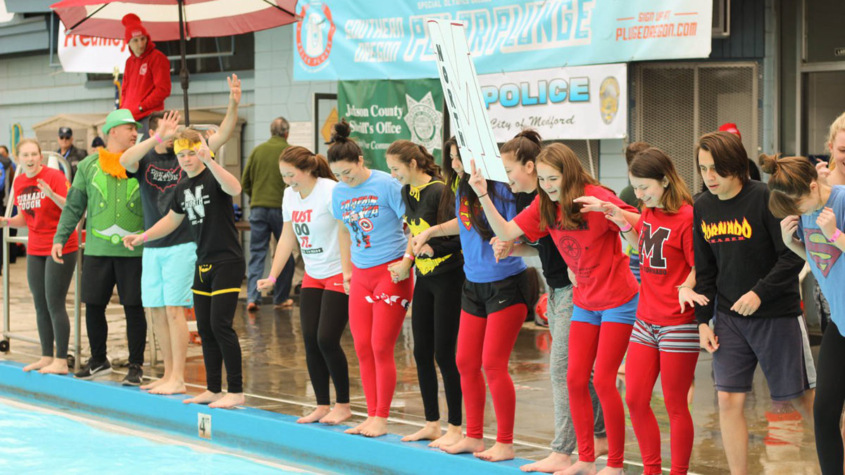
SOU students, staff and faculty have the opportunity to brave icy waters and support local Special Olympics Oregon athletes with intellectual disabilities during the 2019 Polar Plunge event on Saturday, Feb. 16, at Medford’s Jackson Aquatic Center.

The Southern Oregon Polar Plunge will begin at 10:30 a.m. with a costume contest for the participants. The opening ceremonies are scheduled for 11 a.m., followed by the plunge – or plunges.

An SOU team, along with many other local supporters, will participate and support local special needs athletes.

Every student or participant who takes the icy “plunge” must raise $50 in support of the Special Olympics Oregon – half of which goes to local programs for Special Olympics athletes in Jackson, Josephine and Klamath counties. The money helps to provide training, equipment, uniforms, wellness programs and experiences of a lifetime for the athletes.

Organizers recommend plunging with a team of family, friends, co-workers or members of local organizations. SOU will be represented by an Oregon Center for the Arts team organized by student captain Jared Brown. Those who aren’t up for a plunge can still participate by pledging as little as $5 to the SOU team.

More information about the plunge is available on the event website, or by calling (541) 841-6875 or emailing Polar Plunge event manager Kim Andresen – who doubles as division manager for SOU’s Oregon Center for the Arts – at soplunge@soor.org.

The Southern Oregon Polar Plunge is the only pool-based plunge event in Oregon. It is a unique opportunity for individuals, organizations and businesses to help support local Special Olympics  athletes.

Every participant in the plunge will receive a commemorative t-shirt, hot soup and the opportunity to meet the Special Olympics athletes that will benefit from their plunges.

Story by Bryn Mosier, SOU Marketing and Communications intern

Ruggerio-oviedo-study abroad

FACULTY SPOTLIGHT: Alena Ruggerio’s study abroad adventure in Spain

Through a recent study abroad program, 18 Southern Oregon University students and one professor set out to explore and experience the richness of Northern Spain’s culture.

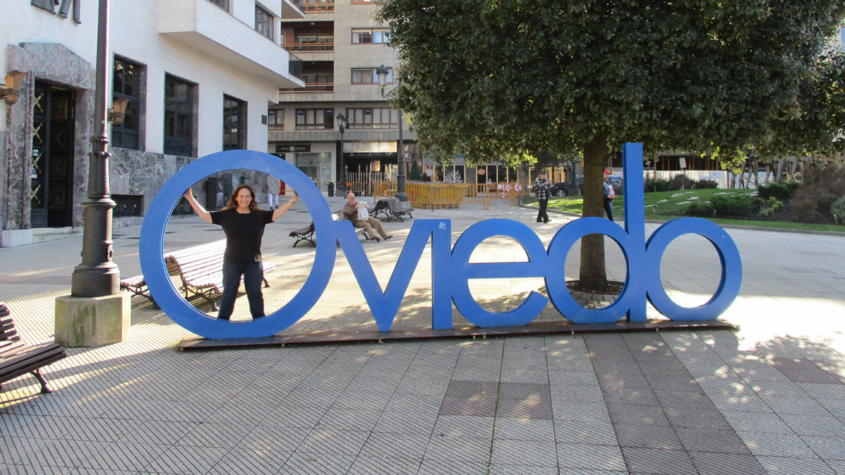
Communication professor Alena Ruggerio organized and led the students on a three-month study abroad excursion to Oviedo, Spain. Ruggerio says the time she spent with her 18 “tesoros” (her treasures) was truly life-changing for her.

Ruggerio teaches courses in public speaking, argumentation and critical thinking, persuasion and other courses in rhetoric. She has received multiple honors and awards, including being voted “Most Warm and Welcoming Professor” by the Associated Students of SOU, and being a recipient of the AHA International Outstanding Visiting Faculty of the Year Award.

How do you believe study abroad experiences benefit students?
I think it’s one of the most important experiences that a student could have. Let’s start with how it enhances your coursework; it was amazing to be able to study something in the classroom and then be able to walk outside, and there’s the thing we’re talking about. We were watching movies in the rhetorical criticism class that were shot in Oviedo and everybody went “Oh my word! We were there! We lived there, right there!” So it brings learning alive in a way that you just can’t do while at a regular college campus.

Benefit number two, obviously, is that it helps you to be more marketable professionally. Because today you aren’t just competing against other college graduates in the United States, you’re competing against everyone across the globe. International study proves that you have an international perspective, and that you can engage in intercultural communication. The kind of person who has the courage, the tenacity and the open-mindedness to succeed in a study abroad program is the kind of person that employers want to hire. So it’s a really nice way to enhance your portfolio when you’re going out on the job market. 

And then the most important, as far as I am concerned, is that study abroad makes you a different person. You are not the same person when you come home as when you left and part of it is you see the world differently. You see your own culture differently, you see your own self differently and you come back with so many more personal connections.

During this study abroad experience, what was your favorite course to teach? Why?
I refuse to choose between the two courses because they were both great, but in different ways. One course I taught was called “Asturian Environmental Persuasion.” Asturias was the name of the region in north-central Spain that we were in, and they’re famous for their wildlife preservation and national forests. So wildlife protection and eco-tourism are big deals in this area. In that class, we studied those issues, and then I brought to the students my knowledge about persuasion strategies and theories. Then each student or group of students created an original persuasion campaign for their term project, where they created original artifacts of persuasion on behalf of a client to try to help them meet their persuasion goals. 

I also taught “Spain in Words and Images,” and basically, that was a Spain-themed version of my rhetorical criticism class. So I taught eight different critical lenses that they could use to analyze examples of public communication. Public communication could run the whole gamut from speeches, to stories, to poems, to songs, to advertisements and billboards, to websites, to social media posts, to architecture, to sculpture, to any kind of example of public communication. And then it was the students’ job every week ‒ and this was my favorite assignment of the entire term ‒ every week I would ask the students to go find some of those examples of public communication that had something to do with Spain and then they would present those to the class. So not only did we learn about how to analyze those examples of communication through these rhetorical criticism lenses, but we also learned a lot about Spain.

What advice do you have for a student who’s interested in studying abroad?
There are all kinds of study abroad opportunities happening all the time, and so my advice to a student would be, do some soul-searching and brainstorming to figure out: “What kind of things do I want to learn? Do I want to take language classes? Do I want to take classes in my major? Do I want to take more general-education university-studies classes? Do I want to have an internship experience? Do I want to have a homestay experience with a family? Do I want to live on a college campus in a dorm? How long do I want to be gone?”

There are study abroad opportunities that are as short as a week or two. So you could do a really short study abroad opportunity, or you could do something that’s a month or two over the summer, or you could do something that’s just a term (like what we did for three months), or you could do something for a year. So figure out how long you want to be gone and then have some idea about what part of the world you might be interested in. Think not just about the location where you will be living, but also where that location puts you in proximity to having additional explorations. And once you’ve thought a little bit about that, my advice would be to go to the Office of International Programs in the SU, and find out what your options are.

I read that you had the chance to visit cathedrals, museums and ancient places in Northern Spain. Were there any locations you weren’t able to visit that you were hoping to?
The travel writer Rick Steves has some really good wisdom about this. He says, “whenever you travel you have to travel with a mindset that someday you will be back in this place.” So that you can do the things that you didn’t get to do, and see the things that you didn’t get to see, because you can’t possibly put pressure on yourself to do and see everything, it’s impossible.

On the hill above Oviedo, on top of Monte Naranco, there’s this enormous statue called “al Sagrado Corazón de Jesús,” sacred heart of Jesus, and it looks over the city. We could see this statue from the university, we could see the statue from my apartment, and the hike up the mountain to get there is beautiful. The view down the mountain from the statue is really beautiful, so most all the students went on this hike up the mountain. I didn’t go, and I really, really wish I had. Unfortunately, I was planning to go up with two students finals week and it was raining. So I didn’t get up Monte Naranco and I really would’ve liked to have done that.

What did you personally gain from this study abroad trip?
My relationship with those 18 students means everything to me. This study abroad opportunity created an environment that is like nothing I have ever experienced teaching at a university in the States. Because it starts with the classroom interaction, and I got to have all 18 of them in both of my classes, which was wonderful because we always had a kind of everyday group meeting together. So we got to all learn the same things together, we had a common base of understanding of where we were at and what we were doing. I’m traveling with them on all of these group excursions, I’m going on all of these tours with them, I’m sitting in on their Spanish class and their Intercultural class. So between them coming to me, and me coming to them, we are each other’s world, basically, for three months. 

I feel like I got to know them in a way that I never get the privilege of getting to know students at SOU. I am certain that every student at SOU is equally as special as these 18, but these are the 18 that I got to know, and the 18 that chose this program are very, very special. And so, long after we come home back to the States, they will still be my tesoros, they are still my treasures, they are still and always will be special to me. That is the most important thing I got out of this trip.

Those interested in venturing into the unknown through a study abroad program may take Ruggerio’s advice and speak to an advisor in the SOU’s Office of International Programs. There are many opportunities waiting for those interested in travel, and SOU offers various forms of support as students explore their options.

Story by SOU student writer Sophie Passerini, @SophiePasserini

Shelee Juarez grant writing SOU

SOU student’s grant writing project bears fruit for preschoolers

SOU English major Shelee Juarez was paired up with the Jackson County Library Foundation when she needed a project last spring for her Grant Writing and Workplace Literacy Class (ENG 329).

The result, several months later, was a $9,000 grant for the JCLF to buy giveaway books for preschoolers in full-time child care – and an invaluable professional experience for Juarez.

It was Juarez’s first grant writing work, and she said that “being thrown into the deep end gave me a better learning experience.”

Juarez first met in May of 2018 with Amy Drake, the JCLF’s executive director. They discussed the foundation’s various programs, and which of those had needs, then zeroed in on the JCLF’s Outreach to Childcare Program. The program is a free service that delivers books to full-time child care sites for preschool children.

Over the course of the summer, Juarez was involved in nearly every aspect of a grant application to the Umpqua Bank Charitable Foundation. Her main role was to answer all of the application questions with information she had gathered either from Drake or the JCLF website.

Everything she wrote was sent for review to Drake, who either approved or revised the material. Juarez also helped write a cover letter and to answer questions including how many clients were served, their economic status and the program description.

With the deadline approaching near the end of September, Juarez created an account with the Umpqua Bank Charitable Foundation for the JCLF’s application materials. Everything she had worked on was transferred into the application system for Drake to submit.

Juarez also said that it was incredibly gratifying to hear from Drake last fall that the JCLF had received $9,000 because of her work.

She plans to use her new knowledge with future employers, either by doing more grant writing or applying the skills to technical writing.

Juarez is set to graduate in March with a bachelor’s degree in English, with a concentration in technical writing and a minor in creative writing. She is a freelance book reviewer and already does work with major publishers and public relations firms.

She is married to her high-school sweetheart and has an 8-year-old son.

Story by Bryn Mosier, SOU Marketing and Communications intern

SOU's Brook Colley finalist for Oregon Book Awards

SOU faculty member a finalist for Oregon Book Awards

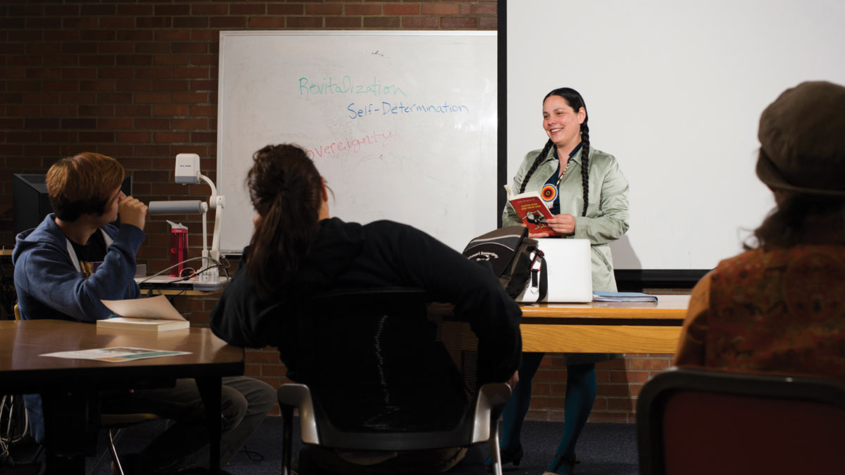
SOU faculty member and alumna Brook Colley has been named a finalist for this year’s Oregon Book Awards in the category of general nonfiction for her book, “Power in the Telling: Grand Ronde, Warm Springs and Intertribal Relations in the Casino Era.”

Colley, an assistant professor for SOU’s Native American Studies program, is one of five finalists for the Frances Fuller Victor Award for General Nonfiction.

Her book examines – in historical, social and political terms – a conflict between the Confederated Tribes of Warm Springs and the Confederated Tribes of Grande Ronde over the Warm Springs tribe’s unsuccessful 15-year effort to develop a casino in Cascade locks. The book was published last April by the University of Washington Press.

“Ultimately, Colley’s engaging examination explores strategies for reconciliation and cooperation, emphasizing narratives of resilience and tribal sovereignty,” a description on Google Books said.

The Oregon Book Awards will be announced at an April 22 ceremony in Portland, hosted by Cheryl Strayed – author of the bestseller-turned-movie “Wild: From Lost to Found on the Pacific Crest Trail.”

The annual awards are presented by the nonprofit organization Literary Arts, Inc., to recognize the best work of Oregon writers in the areas of fiction, poetry, literary nonfiction, drama, graphic literature and literature for young readers. The nonfiction category includes two awards: the Frances Fuller Victor Award for general nonfiction and the Sarah Winnemucca Award for creative nonfiction.

Out-of-state judges are assigned to name award recipients in each category, based on literary merit.

Finalists for the Frances Fuller Victor Award are:

  • .Katrine Barber of Portland, “In Defense of Wyam: Native-White Alliances and the Struggle for Celilo Village,”University of Washington Press
  • Kenneth R. Coleman of Portland, “Dangerous Subjects: James D. Saules and the Rise of Black Exclusion in Oregon,”OSU Press
  • Brook Colley of Phoenix, “Power in the Telling: Grand Ronde, Warm Springs and Intertribal Relations in the Casino Era,” University of Washington Press
  • Mary DeMocker of Eugene, “The Parents’ Guide to Climate Revolution: 100 Ways to Build a Fossil-Free Future, Raise Empowered Kids and Still Get a Good Night’s Sleep,”New World Library
  • Noah Strycker of Creswell, “Birding Without Borders: An Obsession, a Quest and the Biggest Year in the World,” Houghton Mifflin Harcourt

Frances Fuller Victor, who died in 1902, spent 35 years traveling throughout Oregon to interview pioneers and write the region’s history.

Colley was a member of the Ronald E. McNair Scholars Program at SOU, which prepares non-traditional students for post-graduate education. She received bachelor’s degrees in sociology and political science at SOU in 2007, then earned her doctorate in Native American Studies at the University of California-Davis before returning to SOU as a faculty member in 2015.

NEXTGENRADIO: SOU student journalist Erika Soderstrom

NEXTGENRADIO: SOU student journalist Erika Soderstrom earns NPR fellowship

As co-editor of The Siskiyou student newspaper and production assistant for Jefferson Public Radio, communication major Erika Soderstrom has emerged as one of the top student journalists at Southern Oregon University. But even Soderstrom can reinvent her journalism practice, which she did via a NextGenRadio fellowship during Fall Term of 2018.

Co-sponsored by National Public Radio and dedicated to “Finding, coaching and training public media’s next generation,” NextGenRadio completely changed the way Soderstrom views journalism.

She was selected through a competitive application process to participate in a “pop-up” digital journalism training program geared toward news reporting and audio. Organizers hope that cohorts of student journalists can walk away with the skills and knowledge necessary to produce and report their own multimedia stories.

NextGenRadio participants are paired with professional journalists/mentors. Soderstrom partnered with Ericka Cruz Guevarra, a breaking news reporter for Oregon Public Broadcasting.

“I absolutely loved working with her,” Soderstrom said.

Soderstrom and Guevarra were assigned to find a resident who was creating positive community change in the Meadowview neighborhood of Sacramento. This is the neighborhood where Stephon Clark was shot and killed by police on the evening of March 18, 2018.

“Many media outlets went in and reported on how bad the community was and then left,” Soderstrom said. “We were tasked with reconstructing that narrative.”

That’s when Soderstrom found Paul Blanco’s story. Initially, she reached out to  Blanco because he had helped Clark’s grandparents rebuild their home after the police shooting.

However, Soderstrom and Guevarra decided that his personal story was worth showcasing. Blanco had a compelling perspective to share about living and raising his biracial children in the Meadowview community for the past 20 years. In a heart-string-pulling interview, Blanco sheds light on a father’s fear for his biracial children’s lives in the current day and age.

Through this experience, Soderstrom learned that stories change all the time and that “sometimes that’s for the best.” Her experience with NextGenRadio has exposed her to extensive professional connections and resources.

“My favorite part of this experience was being able to present my story and watch the fellow mentees present their final projects as well,” Soderstrom said. “I really enjoyed the community of people I had the opportunity to work with. I also enjoyed the connections that I’ve made and continue to have.”

Story by SOU student writer Sophie Passerini, @SophiePasserini
tall cop substance abuse prevention

“Tall Cop” presents substance abuse awareness training at SOU

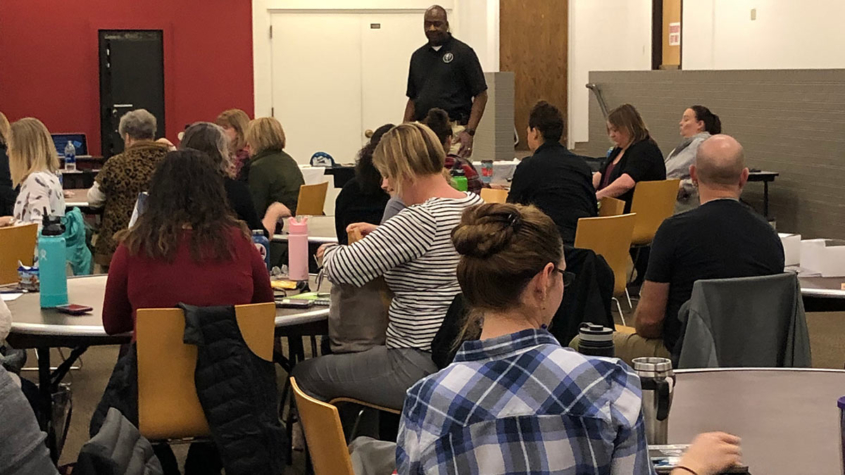
A police officer-turned-substance abuse awareness speaker presented a fairly imposing message during a recent workshop for SOU faculty and staff, and community members from various agencies.

Jermaine GallowayJermaine Galloway — a 6-foot-9 former Division I basketball player – presented his “Tall Cop Says Stop” training to help attendees recognize signs of drug and alcohol abuse.


The program, “High in Plain Sight,” was sponsored by SOU’s Student Health and Wellness Center and was held Jan. 31 in the Stevenson Union Arena. It focused on methods used to conceal alcohol and drug use, games and tendencies at youth parties, non-traditional alcoholic beverages such as fortified energy drinks and “alcopops,” and trends associated with a variety of drugs.

A total of 128 people attended the free SOU event, including faculty or staff from Campus Public Safety, Housing, the Student Health and Wellness Center, Student Support and Intervention, Disability Services, the Student Recreation Center and the Psychology and Criminology and Criminal Justice departments.

There were also Ashland and Medford police officers, parole and probation officers, child welfare caseworkers, CASA volunteers, Juvenile Justice officers and staff from the Maslow Project, Hearts With a Mission, the Medford School District, La Clinica, the Jackson County Citizen Review Board, Jackson County Mental Health and the U.S. Veterans Administration.

The Student Health and Wellness Center organizers said the responses from attendees were positive.

“Everything was well organized (and) the speaker was outstanding,” one commenter said.

“It was so informative and educational,” another said. “I am so happy you were able to bring him to campus.”

Galloway – a former Boise, Idaho police officer – has received various awards and recognitions for his alcohol and drug awareness work. His website said Galloway’s training sessions have reached more than 105,000 people.

Consortium institutions discuss transfers-SOU

Consortium of southern Oregon colleges and universities to strengthen transfer agreements

(Ashland, Ore.) — Delegations from each of the institutions that make up the new Southern Oregon Higher Education Consortium will meet this month to discuss the seamless transfer of credits from colleges to universities and other matters of shared interest. The consortium members are Klamath Community College, Oregon Institute of Technology, Rogue Community College and Southern Oregon University.

The Feb. 25 event, 5:15 to 7:30 p.m. in the Rogue River Room of SOU’s Stevenson Union, will be an expanded version of the annual “Articulation Retreat” that counterparts from SOU and RCC have held for the past several years. This year’s version will include groups from Oregon Tech and KCC.

“We believe this event provides a wonderful opportunity for our SOHEC colleagues to build on what already is an enormously successful collaboration,” said SOU Provost Sue Walsh and RCC Vice President for Instructional Services Leo Hirner in their joint invitation to colleagues at the other institutions.

The consortium, a first-of-its-kind alliance of Oregon colleges and universities, is aimed at streamlining students’ educational pathways and addressing southern Oregon’s specific workforce needs. The ongoing collaborative effort took root with the four institutions’ presidents following a joint lunch meeting a year ago, and was announced in late November with signing events in both Klamath Falls and Medford.

SOHEC is considered a pioneering step toward preparing students and workforce members in the region for a rapidly changing future. It has been endorsed by state officials including the governor and the chair of Oregon’s Higher Education Coordinating Commission.

The Feb. 25 Articulation Retreat will be an opportunity for information-sharing by staff members from the SOHEC institutions’ enrollment services, admissions, academic advising, curriculum and other support services offices. The goal of the event is to improve and expand transfer programs and other cooperative agreements among the schools, to make it easier, faster and more affordable for students to transition from one degree program to the next.

Representatives of media outlets will be welcome to report on the evening’s discussions.

-88-

SOU-food-drive

Governor’s Food Drive will help SOU students in need

The annual Governor’s Food Drive is up and running through February at SOU, and those who contribute can make a real difference for students with unreliable access to food and other community members in need.

All food collected in campaign at SOU will be donated to the university’s Student Food Pantry, and monetary donations will support food assistance programs at ACCESS – the region’s community action agency.

“Our donations of food or pledges of monetary support can make a very real impact on hunger – not on the other side of the world, or in another part of the country, but right here on our campus,” SOU President Linda Schott said in announcing the food drive last month.

Recent studies have shown that as many as half of all U.S. college students have unreliable access to nutritious food. The Governor’s Food Drive draws donations from state government and public university employees throughout Oregon to support the Oregon Food Bank Network – but SOU has arranged for its food donations to go directly to its Student Food Pantry.

The Food Pantry provides SOU students who are in need with as many as 10 items of nonperishable food or hygiene supplies each week.

Red collection bags are expected to be delivered soon by campus mail to all SOU employees. The bags can be filled with non-perishable food items and returned anytime this month to collection barrels located in each building. SOU Dining and A’viands will offer a prize of coffee and snacks to employees from the building that collects the most pounds of donated food.

Employees may also sign up for monthly or one-time payroll deductions and submit the form to Michele Barlow in Human Resources. Each dollar donated is considered the equivalent of four pounds of donated food.

All employees who sign up for a payroll deduction, regardless of the amount, will be entered into a drawing for various prizes.

Other events associated with the food drive include a free concert, featuring student and faculty musical groups, presented by SOU’s Oregon Center for the Arts. Admission to the “Feed Body and Soul” concert – at 7:30 p.m. on Tuesday, Feb. 12, in the Music Recital Hall – will be two cans of food or a cash donation at the door.

SOU Athletics will collect nonperishable food donations at the women’s and men’s basketball games on Feb. 15 against College of Idaho and Feb. 16 against Eastern Oregon University. Tip-offs will be at 5:30 p.m. each day for the women’s games and 7:30 p.m. for the men’s games.