Michael Finley was praised on the floor of the U.S. House of Representatives when he retired in 2001 after more than 32 years with the National Park Service.
California Congressman Jerry Lewis lauded Finley for his dynamic leadership of three of the nation’s largest national parks – Yosemite, Yellowstone and Everglades. Lewis identified Finley’s work with state and local governments, oversight of significant research projects and his international reputation as a conservation expert as exceptional.
For Finley, it was the end of a career that began at Southern Oregon University.
Finley grew up in a Medford family that enjoyed hunting and fishing, as well as music and the arts. He attended SOU as a biology major and planned to become a dentist. He remembers his education as rigorous but caring.
“Small classes, field trips, brown bag lunches and informal coffee discussions contributed to a very rewarding experience for me,” Finley said.
During summer months, Finley worked in a hotshot crew with the U.S. Forest Service, and by the time he earned his bachelor’s degree in 1970, he had discovered that his passion was in the outdoors and not a dental office.
Finley became a park ranger in 1971 at Big Bend National Park in Texas. He remembers the wide-open spaces of the desert and his friendly neighbors in nearby Mexico. But his time in Texas was brief, as he was moved to National Capital Parks in Washington, D.C., for additional training.
During the next five years, Finley moved a lot – to California’s Pinnacles National Monument, Big Basin State Park and Yosemite National Park, and finally to Wyoming’s Grand Teton National Park, where he was responsible for park law enforcement, emergency medical aid, communications, wilderness permitting programs and wildland and structural fire programs.
Finley returned to the nation’s capital in 1978 and began learning the political ropes associated with running the nation’s park system. As a legislative affairs specialist, Finley organized the legislative program for the Western and Pacific Northwest regions. “I worked both the House and Senate sides of the Hill and learned how to generate constituency pressure, develop unusual allies and productively engage state governments to support the Interior Department position,” he recalled.
The first of Finley’s four superintendent positions began in 1981 when he joined Assateague Island National Seashore in Maryland. He was reassigned to Alaska just two years later, providing Finley an opportunity to manage and operate a 13-park territory.
“In Alaska, I learned the importance of protecting large landscapes and ensuring that all the parts of the natural ecosystem were protected and allowed to function in a manner to ensure biological diversity,” he said.
When Finley was named superintendent of Everglades National Park in 1986, he had already crisscrossed the country twice in 15 years. And his time in Florida was not easy. Everglades’ location within 20 miles of a county that was growing by 100,000 people a year threatened an ecosystem that included 13 endangered species.
“I used my SOC biological training to manage and direct over 100 management and research scientists,” Finley recalled.
He immersed himself in the water issues facing Everglades and by the time he left in 1989, he had weathered a number of political battles. Finley’s dogged determination to protect the park and its ecosystem contributed to a reputation as being one of the few Park Service professionals who had the political savvy, negotiating skill and toughness to bring parties together. Finley would be put to the test when he was named superintendent at Yosemite National Park in 1989.
Finley joined Yosemite in the midst of a bitter, long-standing battle between various environmental groups and the Curry Company, which had held the concession contract within the park for more than 90 years. Finley was just 42 years old when he became superintendent, and his enthusiasm and dynamic energy were seen as positives at a time when the park was “being loved to death,” as described in 1993 by the Christian Science Monitor.
Exponential growth in visitors, a lack of federal funding and deteriorating facilities threatened the nation’s second oldest national park. It was natural that Finley became a target for those who took issue with how the park was run. But his experience in bringing warring parties together resulted in the creation of a plan to restore the meadows in Yosemite Valley, move the concession business further from the natural beauty of the park and bring additional revenue into the park for ongoing maintenance and restoration.
t had taken Finley just five years to accomplish what many had viewed as impossible.
He moved to his final superintendent post in Yellowstone National Park, where he served from 1994 until his retirement in 2001. There was no shortage of issues facing Finley upon his arrival – from recreation and bison management to restoration of the cutthroat trout and the reintroduction of the gray wolf. He described one of his greatest achievements as establishing the Yellowstone Park Foundation, which has since raised more than $100 million.
“The contribution of the foundation cannot be overstated,” Finley said. “It allows park staff to undertake projects, studies and restorations that, while not required by law, are required by conscience.”
But Finley didn’t really retire. His 30 years traversing the country gave him a perspective that few enjoy – a keen understanding of the delicate balance in managing the nation’s public lands so future generations can enjoy them. Joining the Turner Foundation in 2001 seemed a logical next step.
As president of the Turner Foundation until 2016, Finley helped distribute more than $334 million in grants to organizations around the world. He described his work at the foundation as apolitical, with the goal simply to help future generations and “to leave the planet better than we found it.” Under Finley’s leadership, the foundation funded projects to “green” the nation’s hotels and restaurants, help create sustainable commercial fishing in Alaska and the Northern Pacific, defend biodiversity by protecting habitats in Africa and Asia, and launch projects to help the nation’s youth.
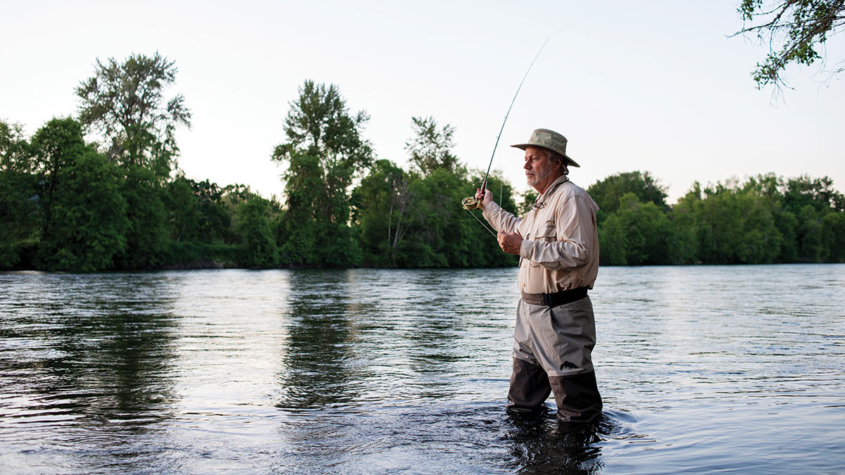
Today, as chair of the Oregon Fish and Wildlife Commission, Finley is in his third act. When he wades into the swirling Rogue River and casts his fly rod, he is both recreational enthusiast and environmental steward. Finley is still maintaining that delicate balance.
Reprinted from the Spring 2018 issue of The Raider, SOU’s alumni magazine