Tag Archive for: school of education

SOU Ashland's Earl Hills and his soft hammer

Earl Hills, a map forward and the hammer

A middle school teacher, a working class past and the quiet labor of keeping a community together when everything breaks.

It was 2020, the year the Rogue Valley felt like it was ending.

Earl Hills was in his early forties, sitting alone with a laptop, staring at a grid of middle school faces on Google Meet. Brand new teacher. Algebra on the screen. COVID everywhere. Deaf in his right ear, barely hearing out of his left.

Twenty minutes into his first lesson, the Wi Fi cut out.

Earl did not log off.

He switched to his phone, kept the class live, texted his principal, and walked out to his truck. He drove across Medford with the students still in his pocket, thirty kids listening to the hum of his engine and the faint squeak of the suspension. Sound has always come to him that way. Incomplete. Underwater. Something his brain has to chase and reorganize before it means anything.

By the time he reached the school, he had ten minutes left in the period.

He finished the lesson from the building.

That instinct did not come from pedagogy. It came from work.

Before he ever taught, Earl delivered things. Furniture for McMahan’s. Ice cream. FedEx routes. Beer trucks for Gold River and Columbia. Early mornings. Heavy loads. Paycheck to paycheck. The kind of work where the route changes and the delivery still has to happen.

At thirty six, he clipped the side of a building in a company truck. A mistake he still calls silly. It ended the job. He had two kids and no map forward.

That night, his wife told him to try college.

She was a 911 dispatcher. She spent her days keeping people on the line while help was on the way. She knew when something had to change.
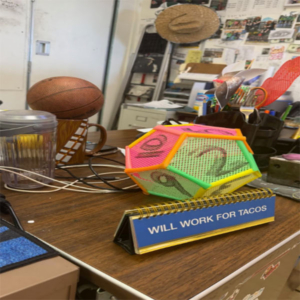
Earl Hills of SOU Ashland and fun on his deskEarl did not want to go back to school. He had barely passed high school, mostly because he needed to stay eligible for sports. Football. Wrestling. Track. He wore number seventy two on the line and thought athletics might be his way out until an ACL tear ended that plan.

School, for him, had always been muffled.

He was deaf in one ear and hard of hearing in the other. Before the IDEA Act, before sophisticated amplification, he wore basic hearing aids that made things louder but not clearer. His mind drifted. Teachers noticed something was wrong early. He learned how to look normal.

It took him decades to understand that normal was the wrong goal.

At Rogue Community College, he started over. Basic English. Remedial math. Classes that did not count toward a degree. He was older than most of the room. His wife’s paycheck kept the family afloat. He relied on mentorship and disability services not as favors, but as structures that made learning possible.

It took more than two years before his credits counted.

When he transferred to Southern Oregon University, math finally clicked. Not because it was easy, but because faculty stood with him. Humor mattered. Time mattered. Being treated as capable, not fragile, mattered. For the first time, struggle was not read as failure but as information.

Then the world shut down.

His first year of teaching happened on screens, with no runway. He learned the systems while they were breaking.

Later that same day, after finishing his lesson from the school building, his phone buzzed again.

When you get home, load the trailer. We have to go.

The Almeda Fire was moving. Their house was one street from evacuation. Earl remembers his youngest panicking, trying to grab everything. He remembers telling her they could not take everything. He remembers keeping his voice calm so his kids could borrow it.

That is the reality of teaching in the Rogue Valley. You do not just teach through curriculum. You teach through smoke.

A few days ago, walking out of Scenic Middle School in mid-February, the valley looked clear again. From the parking lot, you could see Mount McLoughlin rising behind the hills. From Central Point, it is distant but unmistakable, the only peak with a white crest that day, holding the sky in place. The kind of landmark that reminds you where you are and that you are still here.

Earl’s classroom feels like that.

It is not quiet, but it is steady. Star Wars posters on the walls. SpongeBob nearby. In the corner, a Baby Yoda holding a lifesaver. The message is not subtle. You can laugh here. You can struggle here. You will not drown.

He tells students the truth. He was not good at math. On the wall behind him is a poster about growth mindset, not as decoration but as record. He teaches math because he learned, slowly and publicly, that struggling with something does not mean you cannot become good at it.

He listens differently. He watches posture, timing, silence. He knows when a child is carrying something heavy before the child knows how to say it. He knows when to let a kid step out and when to hold the line.

His mother used to say he had broad shoulders for a reason.

He keeps a folder in his room. Thick. Notes from students. Thank you for being my teacher. Thank you for making me want to come to school. Thank you for being the dad I needed.

He does not describe the folder as pride.

He describes it as responsibility.

On his desk is a gray rubber mallet, the kind used when you need force without damage. He calls it the hammer. It is loud enough to get attention, soft enough not to break anything. A tool chosen by someone who knows exactly what happens when you hit too hard.

Earl Hills does not deliver things anymore.

When the system fails. When the fire comes. When a child walks in carrying a world he cannot hear but can still see.

He keeps the kids on the line.

Story by Bryce Smedley, SOU School of Education

Raider Educator Day keynote will be from alumna Katherine Holden

Raider Educator Day with SOU’s School of Education

(Ashland, Ore.) — A keynote address from Katherine Holden, a nationally recognized alumna and principal of Talent Middle School, will highlight the second annual Raider Educator Day, hosted on Saturday, March 9, by Southern Oregon University’s School of Education. The event, from 10 a.m. to 12:30 p.m. in the Rogue River Room of SOU’s Stevenson Union, will serve as a platform for prospective and current students, and recent alumni, to connect with seasoned education professionals, gain insights into the field and explore career opportunities.

Holden, who also taught high school for 10 years at the Ashland School District’s Wilderness Charter School and served seven years as associate principal at Ashland Middle School, has earned acclaim for her innovative contributions to education – particularly in areas including grading reform and equity, diversity and inclusion. She was named the 2022 National Assistant Principal of the Year in recognition of her transformative work in implementing a standards-based grading and reporting system. Her expertise has been shared at conferences across the United States, and she has led professional development for over a thousand educators.

“Katherine Holden’s remarkable career exemplifies what can be achieved by those who embrace the possibilities of innovative teaching and service,” said Vance Durrington, director of SOU’s School of Education, Leadership, Health & Humanities. “Our Raider Educator Day provides a unique opportunity for newcomers to the field of education, or those contemplating education careers, to gain insights from our most respected educators.”

The event will include sessions and mock interviews with superintendents, administrators, hiring managers and teachers from local school districts – many of whom are SOU alumni. School of Education faculty members and student leaders also will participate.

The day is intended to provide valuable career and pathway advice to attendees. Topics will include teacher preparation programs, scholarships and insights into the evolving landscape of the education field.

Raider Educator Day is open at no charge to all who are interested. The schedule and sign-up information are available online.

About Katherine Holden
Holden earned her bachelor’s degree in biology, master’s degree in education and the Administrative License Program at SOU. She currently serves as principal at Talent Middle School and has been actively involved in educational leadership and advocacy.

-SOU-

Student teachers in SOU's School of Education are working remotely

SOU’s graduating student teachers provide value in varied settings

(Ashland, Ore.) — Even the most seasoned educators are currently navigating uncharted territory. But for student teachers in Southern Oregon University’s School of Education, unusual classroom circumstances are coinciding with the culmination of college journeys.

Teaching placements have gone ahead as scheduled – though not exactly as planned – for 110 SOU students who are either seniors or on track to complete the Master of Arts in Teaching (MAT) or Special Education programs this spring. They’re spread across 60 K-12 schools in 12 different districts, from Coos Bay to Klamath Falls and all over the Rogue Valley – with all learning delivered through a variety of remote formats.

John King – SOU’s director for the Division of Education, Health and Leadership – was among those figuring out logistics as the extent of disruption caused by COVID-19 was becoming apparent prior to spring term.

“Fortunately, we have great relationships with the districts and principals, and these (student teachers) are the people they’ll be hiring in the fall, so we’re working towards the same goals,” King said.

“What we’re trying to do is ensure our student teachers are providing added value for schools and students,” he said. “They need to satisfy degree requirements, yes, but we want to make sure they’re not just an extra burden because these schools are already under such enormous pressure in having to redesign a lot of their own work.”

Under normal circumstances, student teachers spend full days during the spring in their respective classrooms, delivering instruction and developing original curriculum. They’re now limited to remote instruction and finding classroom-to-classroom variations in approach, from face-to-face video instruction to packet pick-ups and online work.

MAT candidate Lauren Perkinson falls closer to the latter category in teaching anatomy and physical sciences at North Medford High School. Though she records herself giving lectures, the majority of her work goes into a weekly “learning grid” of activities that includes six options, from which students are asked to complete two.

“Everyone is affected differently and struggling to some extent, especially when it comes to students you have no contact with, but it’s a good lesson in the importance of adaptability as an educator,” Perkinson said. “One of the biggest takeaways is seeing teachers work together and support each other and students however they can, because they care so deeply about them.”

That support extends back to SOU, where ideas and experiences are shared in weekly Zoom classes.

“We’re trying to give them a menu of possibilities based on what each school is doing,” King said. “We have 110 different examples, so it gets incredibly complex very quickly, but that means they’re being equipped not only for their own classrooms, but also hearing experiences of others and seeing how these systems can work together.”

With subject knowledge testing centers closed, King is working with the Oregon Teacher Standards and Practices Commission to offer alternatives for soon-to-be-graduates to complete their state licensure requirements.

“We certainly haven’t figured everything out,” he said. “But we’re trying to approach the situation with generosity and grace and patience, and we’re all learning together.”

Story by Josh McDermott, SOU staff writer

-SOU-