SOU lectures-calculations on chalkboard

WSU’s Watkins to offer thought-provoking mathematical lectures at SOU

Washington State University’s David Watkins will dive into a pair of deep mathematical concepts when he presents lectures at SOU on Friday, May 3, about eigenvalues and mathematical research.

Watkins’ first presentation, at 10:30 a.m. in Taylor Hall, Room 28-31, will offer an examination of eigenvalues for the 36th installment of SOU’s annual Kieval Lecture. He will describe current research into eigenvalues and set straight some commonly taught computational missteps.

“Toward the end of a first course in linear algebra, students learn that matrices have these things called eigenvalues,” Watkins said in describing his lecture. “They will certainly be taught how to compute eigenvalues, but the method that they will learn is wrong!”

The lecture series – which is free and open to the public – was endowed by the late Harry S. Kieval for speakers to address broad popular aspects of mathematics that are attractive to undergraduates and the general public. Kieval was an Ashland mathematician who died in 1994 at age 80.

Watkins – an internationally recognized expert in scientific computing, numerical analysis and numerical linear algebra – will also serve as guest lecturer for this week’s Friday Science Seminar. That presentation, at 3:30 p.m. in Room 151 of the Science Building, will cover the benefits and satisfaction of conducting original mathematic research – even if the same work was done in ancient Greece.

“Anybody can do research,” Watkins said. “If you can figure it out for yourself, the reward in satisfaction will be substantial. And it doesn’t matter whether you discover something new or rediscover things that have been known for a thousand years.”

Watkins is a professor emeritus of mathematics at WSU. He is the author of three books in the field and more than 100 mathematical and scientific publications. He was recently honored, along with several co-authors, by the award of a SIAM Outstanding Paper Prize for work in eigenvalue computations.

The Friday Science Seminar lecture is free and open to the public, and refreshments will be provided by SOU’s STEM Division. The lecture series offers presentations each week on topics ranging from biology to computer science to chemistry.

China's Cangdong village, where many Chinese migrants originated (photo courtesy of Stanford University)

SOU archaeologists participate in study of Chinese migrants’ homeland

(Ashland, Ore.) — Three members of the Southern Oregon University Laboratory of Anthropology (SOULA) have participated in a three-year, international project to investigate everyday lives of 19th century Chinese migrants both in the U.S. and their Chinese homeland.

The Cangdong Village Project – which was confidential until this month – was led by Stanford University and involved researchers from at least seven U.S. universities and one in China.

“This important project marks the first-ever archaeological study of its kind, and we are so excited that SOU was able to play a role in this milestone transnational research project,” said SOU research archeologist Chelsea Rose, who served as a crew chief.

Her work on the project involved multiple trips over the past couple years to Cangdong village in southern China’s Pearl River Delta region – part of a five-county area that was home to most of the Chinese who migrated to the U.S. during the 19th century.

Rose serves as a research faculty member in the SOU Laboratory of Anthropology, where her focus is on archaeology of the American West – particularly the dispersal of an early Chinese migrant population in Oregon. She has been involved in the Stanford-based Chinese Railroad Workers in North America Project, which led to the Cangdong project.

She was joined on the Cangdong project by fellow SOULA employees Katie Johnson-Noggle, who served as the project’s cartographer and graphic designer, and Tyler Davis, who worked as a field researcher.

The project examined the practices of Cangdong Village residents during about a 50-year period in the late 1800s and early 1900s. Migrants from the area left to escape violence and economic hardship, and arrived in the American West to work in mines and railroads. They established flourishing Chinatowns throughout the region until many were forced to flee again by anti-Chinese violence and the Chinese Exclusion Act of 1882.

Researchers at Cangdong village found a variety of Chinese ceramic bowls, some of which matched bowl types that have been found at railroad camp sites in the U.S. They also excavated British-made ceramic plates and American-made medicine bottles and clothing from the migration period.

Rose and other researchers have excavated sites where Chinese migrants lived and worked in Oregon and elsewhere in the U.S. West, but the areas from which they migrated had not been studied until Stanford initiated the international research effort. Stanford University was established with much of the wealth that Leland Stanford earned helping to oversee construction of the western half of the First Transcontinental Railroad.

A total of 27 archaeologists, anthropologists and others are listed as team members for the Cangdong Village Project. Participating institutions include SOU, Stanford, China’s Wuyi University, University of New Orleans, University of Massachusetts at Boston, San Francisco State University, Humboldt State University and Durham University.

-SOU-

SOU Digital Cinema in studio

HECC gives green light for launch of Digital Cinema degree at SOU

(Ashland, Ore.) — Oregon’s Higher Education Coordinating Commission gave final approval today for a new Digital Cinema degree program that will begin this fall at Southern Oregon University and prepare students for careers in film and other forms of visual media.

Members of the HECC, whose approval is needed for all new degree programs at the state’s seven public universities, OK’d the SOU program (https://sou.edu/academics/digital-cinema/) without discussion. It had previously been reviewed and endorsed by both the SOU Board of Trustees and the state universities’ provosts council.

“We’re excited to finally offer a major for the students out there who are looking for a ‘film school’ education,” said Andrew Gay, the program coordinator and associate professor of digital cinema at SOU.

“But we also know that today’s student filmmakers need to be prepared for all kinds of visual storytelling careers that go beyond the traditional ‘film school’ format,” he said. “Here at SOU, students will get that immersion in both worlds — in traditional filmmaking and in new digital worlds like streaming television and virtual reality.”

The new major will build upon the success of the existing Digital Cinema concentration within SOU’s Communication major, while introducing several new courses and immersive experiences for student filmmakers – including required coursework related to innovation.

The program’s centerpiece is a new, 12-credit spring immersion called “The Crew Experience,” in which student filmmakers will spend an entire term learning on location, collaborating under the supervision of experienced professionals on the sets of a significant film projects. Students will apply and interview for their crew positions based on the experiences, skill levels and portfolios of work they have developed in preceding classes.

No other film or media program in the Pacific Northwest offers such an experiential approach to professional production training.

Curriculum for the new program was designed with input from an advisory council of current and former students, film and media industry professionals, and experienced educators in the field. It was designed with both state and regional employment trends in mind.

“Economic diversification is key to the health and wealth of southern Oregon, and the media production sector is a promising target for growth in this region, based on existing assets and infrastructure,” said State Sen. Jeff Golden, who served on the new program’s advisory council.

-SOU-

nominations for McNair Scholars program

Promising students sought for SOU McNair Scholars Program

SOU faculty and staff are asked to help identify and nominate students for the next cohort of SOU’s McNair Scholars Program, which has prepared eligible undergraduate students for post-graduate education since 2003.

A majority of past participants in the program have said they were encouraged by faculty or staff to apply, so the program’s director is seeking nominations of students who have shown academic promise and an interest in graduate school. Prospective McNair Scholars should be sophomores, juniors or early seniors.

Those who wish to be considered this spring for the 2020 cohort must submit their completed application packets by 3 p.m. on May 6.

The SOU program offers one-to-one guidance from faculty mentors as it helps participants complete their undergraduate degrees, enroll in graduate school and prepare for doctoral studies. SOU’s McNair program serves 28 undergraduate scholars each year, and more than a dozen alumni have completed their doctoral programs since the program began 15 years ago.

Student participants in the nation’s 187 currently funded McNair programs are considered “targets of recruitment” for graduate admissions officers. They are offered fully-paid visitation opportunities and often given offers of admission that include all-expenses-paid packages with stipends for living expenses.

Benefits and resources available free of charge to participants in SOU’s McNair Scholars Program include seminars on topics pertinent to pre-doctoral students, advising, tutoring, access to a resource library, help with graduate school applications, travel assistance and more.

The program is named for Ronald E. McNair, who stood up for civil rights as a youth before becoming a physicist and astronaut. He was the second African-American to fly in space, but died in the 1986 explosion of the space shuttle Challenger.

The McNair program was initiated in 1989 by the U.S. Department of Education to increase doctoral studies by students from underrepresented and disadvantaged groups.

Those wishing to recommend a student for SOU’s McNair program should send the student’s name, email address and undergraduate major to program director Dee Southard at McNair@sou.edu.

Mike Rousell-SOU-Surprise-TEDx

Surprise! SOU’s Rousell discusses the brain, dopamine and change at TEDx

Mike Rousell, an associate professor of education at SOU, still remembers the surprise response he received from a teacher after complaining about his childhood dyslexia and learning difficulties. “Why don’t you become a teacher?” his instructor asked.

What that teacher may not have realized is that the unexpected comeback may have produced fertile ground in which the seeds of Rousell’s confidence as an academic and future educator could take root. Rousell has spent more than three decades as a psychologist and professor analyzing what he calls “surprise-driven formative events,” and offered a fast-paced, informative – and surprising – presentation at a TEDx Talks event held earlier this year in Salem and published recently on YouTube.

“Surprises to beliefs we hold about ourselves can be defining and formative,” he told the TEDx audience. “So now that you know what surprise-driven belief formation looks like, what does a surprise-driven formative event look like?

“Samantha used to think that her shyness was a weakness – that is, until one day when her swim coach named her captain of the swim team. He told the team, ‘She may be shy, but when she talks you’re going to want to listen.’ Since that surprise comment, she now feels quietly powerful.”

Rousell, who has taught full-time at SOU since 2008, was one of 11 speakers at the January TEDx event, the sixth in a Salem series. His 12-minute talk – “Surprise! How Your Brain Secretly Changes Your Beliefs” – examined how the human brain is affected by surprise and the groundwork for reevaluation is laid.

He said that surprise produces a jolt of dopamine, a chemical that enables the transmission of signals among the brain’s nerve cells. He said it’s “essentially a neurological error signal” that to human ancestors signaled inherent danger or opportunity.

And Rousell portrayed strategic surprise as a “life hack” that can enrich others’ lives.

“If you’re a teacher and you have a student who is frozen with the fear of making mistakes, catch that student making a mistake,” he said. “They will be surprised, and they will expect criticism. Surprise that student instead and say, ‘Your eagerness to make your mistakes so willingly make you a strong learner.’

“If you surprised that student, they got a burst of dopamine and they have to make sense of that. So now when they make those inevitable mistakes, they get a little hit of dopamine … which says, ‘Fight on, because you’re a strong learner.’ And that is the signal feature of a growth mindset.”

Rousell received his bachelor’s degree in education from the University of Alberta, and his master of education and doctorate from the University of Oregon. He taught elementary, middle and high school in Edmonton, Alberta, before accepting his position in the School of Education at SOU, and also has worked in private practice and school counseling as a certified psychologist.

He told the TEDx audience that humor is an effective tool in changing people’s beliefs, because of its frequent use of an element of surprise – and he offered an example. Rousell said that a consequence of his line of study is that he is often asked what has been the biggest surprise in his life.

“I was having a little disagreement with my wife and at the end of it she looked at me and she said, ‘you might be right,’” he said.

SOU Honors College Cherstin Lyon

New director hired at SOU Honors College

(Ashland, Ore.) — Cherstin Lyon – a history professor and co-director of the Faculty Center for Excellence at California State University, San Bernardino – has been hired as director of the Southern Oregon University Honors College following a national search. She will begin work at SOU on July 31.

Lyon, who visited the university for interviews in January, will be the second director of the Honors College. She will succeed Ken Mulliken, who created the Honors College in 2013 and left last summer to take a position at the University of Illinois, Springfield.

“I am confident that this outstanding program is in good hands and that Cherstin will help guide it to new heights,” SOU Provost Susan Walsh said in announcing the hire to campus on Thursday.

Prakash Chenjeri, a philosophy professor at SOU who has served in various honors programs for many years, is currently interim director of the Honors College and will continue in that role until Lyon’s arrival.

Lyon has served on the CSU-San Bernardino faculty since 2006. She also serves as a faculty associate in CSUSB’s Office of Community Engagement and on the Program Transformation Committee for its University Honors program.

She has served previously as an instructor at the University of Arizona, an adjunct faculty member at Utah Valley University and a graduate teaching fellow at both the University of Arizona and the University of Oregon.

Lyon received her bachelor’s and master’s degrees in history from the UO, and her Ph.D. from Arizona. Her doctoral thesis was on “Prisons and Patriots: The Tucsonian Draft Resisters of Conscience Of World War II,” and she is author of the book, “Prisons and Patriots: Japanese American Wartime Citizenship, Civil Disobedience and Historical Memory.”

The Honors College at SOU, currently in its sixth year, accepts students from any major. All who are accepted into the Honors College participate in specialized programs and hands-on experiences outside the classroom.

-SOU-

Creativity Conference at SOU

Second annual Creativity Conference at SOU to expand global conversation

Southern Oregon University will expand the global academic discussion of imagination and ingenuity this summer by presenting its second annual Creativity Conference at SOU – a four-day event expected to attract hundreds of participants from around the world.

The conference – on the SOU campus July 11-14 – is intended primarily for those who study creativity, but will also offer insights for those who consider themselves creative and those looking to leverage creative thinking in their fields.

Presentations will cover a wide variety of academic specialties, and working professionals will be able to participate in applied workshops featuring hands-on activities for developing and using creativity in the workplace.

Last year’s inaugural SOU Creativity Conference drew more than 300 people from 28 countries, to participate in about 175 presentations.

“I have been immersed in this field for over 30 years,” said Mark Runco, executive director of the SOU Creativity Conference and recently hired director of Creativity Research and Programming for the university.

“I have never seen an event anywhere near the one we had at SOU in 2018 – and will have again in July 2019,” he said. “Heck, 28 countries were represented, and many ‘big names’ in the field were here, and will be again. There really has been nothing like this – ever, anywhere.”

Runco has served as an endowed professor and creativity researcher at the University of Georgia and a research fellow at the American Institute of Behavioral Research and Technology. He is editor of the Creativity Research Journal and co-editor of the Encyclopedia of Creativity, and has served as president of a division of the American Psychological Association dedicated to art, creativity and aesthetics.

Keynote speakers at this year’s Creativity Conference at SOU are Teresa Amabile, a Baker Foundation professor at Harvard Business School; and Dean Simonton, a professor emeritus of psychology at the University of California, Davis.

Amabile’s work focuses on individual creativity and productivity, and organizational creativity and innovation. Her keynote address will be presented by LEGO, a corporate sponsor of this year’s event.

Simonton’s studies have focused on human intelligence, creativity, greatness and the psychology that drives science.

Other featured speakers at this year’s conference will include Min Tang, director of the Institute for Creativity and Innovation at Germany’s University of Applied Management; Ron Beghetto, professor and director of the University of Connecticut’s Innovation House; Yael Katz, vice provost for academics at Canada’s Sheridan College; Jonathan Feinstein, professor of creative development at Yale University; Adam Green, of Georgetown University, founder and current president of the Society for the Neuroscience of Creativity; and Roger Firestien, senior faculty member and president of Innovation Resources, Inc., at State University of New York, Buffalo State.

Dan DeNeui, a conference organizer and director of SOU’s Division of Social Sciences, said the annual event provides an opportunity for creativity researchers to collaborate and broaden their network.

“The conference (last year) was a great way to get together and talk about how we can use creativity to solve problems,” DeNeui said.

This year’s program has not yet been announced, but is likely to be wide-ranging. Last year’s presentations ranged from “Fostering Creativity Through Virtual Environments” and “Attitudes toward creative people and innovators,” to “Rumination and Reflection During Art-Making.”

SOU has adopted the goal of serving as Oregon’s “university for the future.” Its strategic plan – the university’s roadmap into the future – places an emphasis on creativity, innovation and other human skills that augment technical skills and are particularly valued by employers.

-SOU-

Ignorance and Wisdom-books and flowers

Campus Theme: Ignorance and Wisdom presentations this month

The 11th year of SOU’s Campus Theme continues with a pair of presentations this month, beginning at 7 p.m. on Wednesday, Feb. 20, with “To not know: Is It Ignorance or Wisdom?” by Fred Grewe, chaplain at Providence Medford Medical Center.

The talk, which is free and open to the public, will be in Room 319 of the Stevenson Union. It will be followed on Thursday, Feb. 28, by “Wisdom and Compassion: Awakening Human Capacities to Build Resilient Communities,” by Paul Condon, an assistant professor of psychology at SOU. That presentation will be at 7 p.m. in Room 323 of the Stevenson Union.

Both events are part of SOU’s campus theme for the 2018-19 academic year, “Ignorance and Wisdom.” This year’s campus theme presentations all explore those two concepts and their relationships.

The university adopts a theme each year for a series of lectures and discussions. Last year’s was “Truth,” and the previous year was “Shapes of Curiosity.” The series, presented by SOU’s Arts and Humanities Council, creates opportunities for students, faculty, staff and community members to engage in intellectually stimulating conversations.

In this week’s talk, “To Not Know,” Grewe will explore the teachings of various religious thinkers – Christian, Buddhist, Taoist and Jewish – and what each has contributed to the understanding of what constitutes both wisdom and ignorance. A promotional flyer for the event cites the words of the late Supreme Court Justice Potter Stewart, when asked in a pornography case to define the threshold for obscenity: “I know it when I see it.”

Grewe has served as chaplain for the Providence Hospice in Medford since 2012, and served previously as a hospice chaplain at Asante Ashland Community Hospital and at St. Louis University Hospital in Missouri. He has published several articles and books about dying and the clergy’s role in end-of-life preparations.

The Feb. 28 presentation, “Wisdom and Compassion,” will look at the conflict and divisiveness that increasingly characterizes today’s political world. The talk will draw on Buddhist philosophy and cognitive science, and suggest that a fundamental problem is the mind’s tendency to portray others in limited ways that deny their full humanity.

Condon will explore a potential solution: current research on addressing relational and societal challenges through meditation and the human capacities for wisdom and compassion.

Condon’s research lab at SOU examines the social and relational processes that contribute to mental and physical wellness – particularly, through compassion and meditation.

SOU faculty members are asked to encourage their students to attend and participate in the Campus Theme presentations.

Friday Science Seminar-Paddock-Alzheimer's

Friday Science Seminar: SOU alumna and faculty member on Alzheimer’s

Brie Paddock, an SOU alumna and assistant professor in the university’s Biology Department, will discuss the role of metals in Alzheimer’s disease during a Friday Science Seminar on Friday, Feb. 22.

Paddock’s lecture will be in the Science Building Auditorium (Room 151) from 3:30 to 5 p.m. The lecture is free and refreshments will be provided by SOU’s STEM Division.

Alzheimer’s Disease afflicts 5.3 million Americans, has few current treatments and no known cure. The progressive, neuro-degenerative disease involves multiple factors – including genetic and environmental – and is characterized by abnormal plaque deposits and “tangles” in the brain, which disrupt communication between synapses  and lead to losses in memory function.

Paddock’s talk will focus on current research on the amyloid hypothesis of Alzheimer’s, including the role of metals in the disease’s progression.  A small percentage of cases are caused by a single gene, including rare mutations in Amyloid Precursor Protein and associated proteins.

Paddock joined SOU’s Biology Department in 2018, and teaches courses in animal physiology and principles of biology. Her background also includes molecular biology, immunohistochemistry and human physiology.

Her research centers on synaptic function using the fruit fly (Drosophila) model. Paddock helped develop a fruit fly model of Alzheimer’s disease, and uses the model to test the role of oxidative stress and environmental factors in the disease’s development, particularly in memory function and synaptic structure.

Her previous work included a determination of the molecular mechanism of calcium-dependent exocytosis at the synapse, a key event in cell-to-cell communication in the nervous system.

SOU’s Friday Science Seminar program offers presentations each week on topics ranging from biology to computer science to chemistry.

Ruggerio-oviedo-study abroad

FACULTY SPOTLIGHT: Alena Ruggerio’s study abroad adventure in Spain

Through a recent study abroad program, 18 Southern Oregon University students and one professor set out to explore and experience the richness of Northern Spain’s culture.

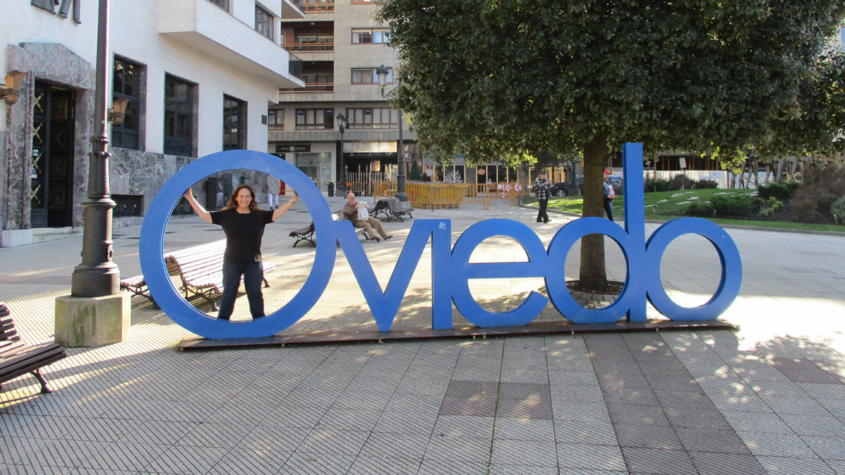
Communication professor Alena Ruggerio organized and led the students on a three-month study abroad excursion to Oviedo, Spain. Ruggerio says the time she spent with her 18 “tesoros” (her treasures) was truly life-changing for her.

Ruggerio teaches courses in public speaking, argumentation and critical thinking, persuasion and other courses in rhetoric. She has received multiple honors and awards, including being voted “Most Warm and Welcoming Professor” by the Associated Students of SOU, and being a recipient of the AHA International Outstanding Visiting Faculty of the Year Award.

How do you believe study abroad experiences benefit students?
I think it’s one of the most important experiences that a student could have. Let’s start with how it enhances your coursework; it was amazing to be able to study something in the classroom and then be able to walk outside, and there’s the thing we’re talking about. We were watching movies in the rhetorical criticism class that were shot in Oviedo and everybody went “Oh my word! We were there! We lived there, right there!” So it brings learning alive in a way that you just can’t do while at a regular college campus.

Benefit number two, obviously, is that it helps you to be more marketable professionally. Because today you aren’t just competing against other college graduates in the United States, you’re competing against everyone across the globe. International study proves that you have an international perspective, and that you can engage in intercultural communication. The kind of person who has the courage, the tenacity and the open-mindedness to succeed in a study abroad program is the kind of person that employers want to hire. So it’s a really nice way to enhance your portfolio when you’re going out on the job market. 

And then the most important, as far as I am concerned, is that study abroad makes you a different person. You are not the same person when you come home as when you left and part of it is you see the world differently. You see your own culture differently, you see your own self differently and you come back with so many more personal connections.

During this study abroad experience, what was your favorite course to teach? Why?
I refuse to choose between the two courses because they were both great, but in different ways. One course I taught was called “Asturian Environmental Persuasion.” Asturias was the name of the region in north-central Spain that we were in, and they’re famous for their wildlife preservation and national forests. So wildlife protection and eco-tourism are big deals in this area. In that class, we studied those issues, and then I brought to the students my knowledge about persuasion strategies and theories. Then each student or group of students created an original persuasion campaign for their term project, where they created original artifacts of persuasion on behalf of a client to try to help them meet their persuasion goals. 

I also taught “Spain in Words and Images,” and basically, that was a Spain-themed version of my rhetorical criticism class. So I taught eight different critical lenses that they could use to analyze examples of public communication. Public communication could run the whole gamut from speeches, to stories, to poems, to songs, to advertisements and billboards, to websites, to social media posts, to architecture, to sculpture, to any kind of example of public communication. And then it was the students’ job every week ‒ and this was my favorite assignment of the entire term ‒ every week I would ask the students to go find some of those examples of public communication that had something to do with Spain and then they would present those to the class. So not only did we learn about how to analyze those examples of communication through these rhetorical criticism lenses, but we also learned a lot about Spain.

What advice do you have for a student who’s interested in studying abroad?
There are all kinds of study abroad opportunities happening all the time, and so my advice to a student would be, do some soul-searching and brainstorming to figure out: “What kind of things do I want to learn? Do I want to take language classes? Do I want to take classes in my major? Do I want to take more general-education university-studies classes? Do I want to have an internship experience? Do I want to have a homestay experience with a family? Do I want to live on a college campus in a dorm? How long do I want to be gone?”

There are study abroad opportunities that are as short as a week or two. So you could do a really short study abroad opportunity, or you could do something that’s a month or two over the summer, or you could do something that’s just a term (like what we did for three months), or you could do something for a year. So figure out how long you want to be gone and then have some idea about what part of the world you might be interested in. Think not just about the location where you will be living, but also where that location puts you in proximity to having additional explorations. And once you’ve thought a little bit about that, my advice would be to go to the Office of International Programs in the SU, and find out what your options are.

I read that you had the chance to visit cathedrals, museums and ancient places in Northern Spain. Were there any locations you weren’t able to visit that you were hoping to?
The travel writer Rick Steves has some really good wisdom about this. He says, “whenever you travel you have to travel with a mindset that someday you will be back in this place.” So that you can do the things that you didn’t get to do, and see the things that you didn’t get to see, because you can’t possibly put pressure on yourself to do and see everything, it’s impossible.

On the hill above Oviedo, on top of Monte Naranco, there’s this enormous statue called “al Sagrado Corazón de Jesús,” sacred heart of Jesus, and it looks over the city. We could see this statue from the university, we could see the statue from my apartment, and the hike up the mountain to get there is beautiful. The view down the mountain from the statue is really beautiful, so most all the students went on this hike up the mountain. I didn’t go, and I really, really wish I had. Unfortunately, I was planning to go up with two students finals week and it was raining. So I didn’t get up Monte Naranco and I really would’ve liked to have done that.

What did you personally gain from this study abroad trip?
My relationship with those 18 students means everything to me. This study abroad opportunity created an environment that is like nothing I have ever experienced teaching at a university in the States. Because it starts with the classroom interaction, and I got to have all 18 of them in both of my classes, which was wonderful because we always had a kind of everyday group meeting together. So we got to all learn the same things together, we had a common base of understanding of where we were at and what we were doing. I’m traveling with them on all of these group excursions, I’m going on all of these tours with them, I’m sitting in on their Spanish class and their Intercultural class. So between them coming to me, and me coming to them, we are each other’s world, basically, for three months. 

I feel like I got to know them in a way that I never get the privilege of getting to know students at SOU. I am certain that every student at SOU is equally as special as these 18, but these are the 18 that I got to know, and the 18 that chose this program are very, very special. And so, long after we come home back to the States, they will still be my tesoros, they are still my treasures, they are still and always will be special to me. That is the most important thing I got out of this trip.

Those interested in venturing into the unknown through a study abroad program may take Ruggerio’s advice and speak to an advisor in the SOU’s Office of International Programs. There are many opportunities waiting for those interested in travel, and SOU offers various forms of support as students explore their options.

Story by SOU student writer Sophie Passerini, @SophiePasserini