Energy resilience at SOU Ashland

SOU OK’d to use federal money advancing energy resilience

(Ashland, Ore.) — Southern Oregon University has been given a green light to use a $2 million allocation, approved by Congress in December 2022, to promote and advance renewable energy, energy resilience and related programs and partnerships on campus and throughout the region. The work will help to transform the SOU campus into a living laboratory and launch a talent pipeline for southern Oregon.

The congressional allocation was originally intended to be used in the construction of solar arrays on SOU’s parking lots and rooftops, but those purposes were modified to meet the requirements of  the federal Department of Energy. The university received notification from the DOE on Friday that it can “proceed with all activities under these (revised) documents.”

“We have developed a strong, impactful program of work and it is exciting to get the go-ahead,” said Becs Walker, SOU’s director of sustainability. “The focus is positioning SOU as an energy resilience leader in the region and developing experiential learning in the space of community resilience and leadership.”

The amended plan lays out three pathways for using the federal money in ways consistent with the original proposal’s intent: to advance renewable energy generation and energy resilience leadership; establish SOU’s Community Resilience and Leadership program; and expand educational and workforce partnerships in the southern Oregon community.

Energy generation and resilience
SOU will leverage the federal allocation to enhance its capacity and leadership in renewable energy generation and community energy resilience – directly supporting its strategic institutional goal of achieving 100% daytime electricity generation through onsite solar arrays paired with robust energy storage and resilience capacity. The funding will support a comprehensive analysis of existing capacity and forecast future energy demand, and an evaluation of the most effective technology solutions  including solar installations, battery storage and management of energy demand.

The university will develop an energy resilience plan to position the university as a regional center for energy innovation and economic development. The study will explore the integration of battery storage,  bi-directional charging infrastructure and the potential deployment of community-facing microgrids – power grids that use local energy resources and operate independently from the main electrical grid. The plan will assess how those technologies can support emergency preparedness and long-term energy security for SOU’s campus and the surrounding region.

SOU will also use a portion of the federal allocation to appoint a two-year postdoctoral scholar to focus on the future of microgrid systems and energy resilience at the university.

Community Resilience and Leadership program
Another part of the $2 million federal appropriation is already at work, funding a new Community Resilience and Leadership (CRL) Student Fellows Program – the flagship curricular initiative of SOU’s Institute for Applied Sustainability (IAS). The 12-month student fellowship is being developed in partnership with academic programs and departments across campus to link the university’s solar infrastructure with its academic offerings around sustainability. It prepares emerging leaders from all majors to take on the challenges of energy, environmental and community resilience through hands-on learning and real-world projects.

The fellowships – available to 15 students per year –combine coursework, field experience and career pathways, and offer mentorship, professional skill development, experience working on regional challenges and stipends to support students’ participation. The federal funding will allow the program to run for three years, providing a runway for sustained support through private giving in the future.

“By giving our students the tools and the space to create local solutions to local needs, we are preparing them to lead in a rapidly changing world that demands grit, a profound commitment to making a difference and comprehensive systems thinking,” said Walker, the SOU sustainability director.

Student fellows begin in the winter and spring terms of their junior year, serving apprenticeships for the Local Innovation Lab, which started as a response to local problems caused by the COVID-19 pandemic and the September 2020 Almeda Fire. A six-week “summer intensive” experience is next, featuring field-based modules and direct engagement in projects such as energy infrastructure, navigating extreme smoke and heat events and community resilience. The fellows then start their senior year by mentoring peers, doing internships with partners or developing capstone projects that make them workforce-ready.

Community educational and workforce partnerships
The federal funding will also support a more robust and accessible experiential learning ecosystem at SOU. A core group of employer partners will offer recurring internships, expanding students’ professional networks and increasing the likelihood that graduates will remain in southern Oregon. In parallel, partnerships with workforce boards and regional funders will play an essential role in sustaining the program over time.

SOU has been awarded a total of $5.8 million in state and federal funding in recent years to support energy generation and energy resilience on campus – three $1 million grants from the state’s Community Renewable Energy Program, $800,000 through an allocation from the Oregon Legislature for Sustainability Funding at Oregon’s Technical and Regional Universities and the $2 million congressional appropriation from 2022.

The university now has 10 solar arrays on its campus, totaling 804.21 kW of capacity, in addition to one array on the Higher Education Center in Medford and six pole-mounted STrackers located on land leased to a nonprofit. Three of the on-campus arrays support net-zero buildings, underscoring SOU’s commitment to deep decarbonization and long-term energy savings.

-SOU-

SOU Ashland Computer Science presentation to exclusive AI organization

SOU AI work presented to exclusive organization

SOU Computer Science faculty member Bernie Boscoe and two of her students presented information to an exclusive organization of artificial intelligence researchers earlier this month on SOU students’ use of computer vision to glean data from camera traps at the future site of a wildlife crossing over Interstate 5 south of Ashland.

The poster presentation was given in Washington D.C., at the second annual meeting of the National Artificial Intelligence Research Resource (NAIRR), a National Science Foundation-supported group on the cutting edge of artificial intelligence research.

Boscoe and SOU Computer Science students Katherine Nunn and Brayden Stach presented their poster, “Teaching Scalable Wildlife Image Processing with NAIRR Jetstream2 GPUs to Undergraduates.” GPUs – Graphics Processing Units – are electronic circuits used to accelerate image rendering, process video and train artificial intelligence.

“The module allows students to engage with wildlife data from Oregon while learning scalable computational workflows,” Boscoe and her team wrote in an abstract about their presentation.

Their poster included step-by-step guidance that enables other researchers and students to apply the same procedures used to collect data for the Oregon wildlife crossing to their own wildlife images and video datasets.

“By presenting a transparent, modifiable pipeline, the module allows students to experiment, troubleshoot common GPU-related issues and reflect on computational tradeoffs,” the poster abstract said.

Boscoe, an SOU assistant professor of computer science who builds and researches infrastructures and tools to help domain scientists do their work, has been collaborating with SOU associate professor of Environmental Science Karen Mager for more than three years to study wildlife patterns along I-5 and better understand regional needs for wildlife crossings. The data their students generated by using camera traps was a key component of a feasibility study that identified the Mariposa Preserve of the Cascade-Siskiyou National Monument as the priority site for an overpass.

The wildlife crossing, which has received a total of $37 million in federal and state funding, will span the freeway’s northbound and southbound lanes 1.7 miles north of the Oregon-California state line to help reduce vehicle-wildlife collisions. Construction is expected to begin as early as 2028.

The NAIRR was established by the NSF as a pilot in 2024, and now supports more than 600 research projects and 6,000 students across all 50 states, Washington, D.C. and Puerto Rico. It is intended to be a national infrastructure to provide critical computing, software, data, models, educational resources and expertise that the research and education communities need to advance AI innovation. Its annual meeting is an invitation-only gathering of researchers, educators, innovators, students and partners.

SOU Ashland faculty at DECA conference

SOU School of Business faculty engage students at DECA Conference

Faculty members from the Southern Oregon University School of Business recently participated in the Oregon DECA State Career Development Conference, supporting and mentoring high school students preparing for careers in business and entrepreneurship.

MBA Program Coordinator Douglas Daley; senior instructor Jeremy Carlton, Ph.D.; and assistant professor Jacob Ongaki, Ph.D., represented SOU at the conference that was held in Portland on Sunday through Tuesday, Feb. 22-24, and attended by approximately 1,300 high school business students from across the state. The three faculty members served as judges for multiple student competitions, evaluating presentations from some of Oregon’s most talented young business leaders.

On the second day of the conference, the faculty members hosted an exhibit booth where they met with students interested in learning more about SOU and the School of Business. They spoke throughout the day with prospective students about academic programs, career preparation and opportunities available through SOU.

Daley facilitated a workshop later that afternoon that was attended by 40 DECA students focused on the evolving role of artificial intelligence in education and business. The session emphasized how students can use AI tools to support their thinking and creativity while maintaining strong critical-thinking skills. Students were highly engaged throughout the workshop and expressed enthusiasm about learning how AI can be used as a tool to strengthen their ideas rather than replace their own thinking.

“The goal isn’t to replace thinking with AI,” Daley explained during the session. “It’s to use these tools to strengthen your thinking and help you explore ideas more deeply.”

The conference concluded with a round of competitive events, where the SOU faculty again served as judges and had the opportunity to interact with students demonstrating impressive business knowledge, professionalism and creativity.

DECA, which was formed in 1948 as the Distributive Education Clubs of America, is a not-for-profit student organization with more than 290,000 high school members, 6,000 advisors and 15,000 postsecondary collegiate division members around the world. Typical student members of DECA are actively involved in preparing for successful careers in marketing, finance, hospitality and management.

Oregon’s DECA association has more than 2,000 members.

Participation in events such as the Oregon DECA State Career Development Conference allows SOU faculty to support the next generation of business leaders while also sharing the university’s programs with high-achieving students considering their college options.

The SOU School of Business continues to build strong relationships with organizations like DECA as part of its commitment to experiential learning, mentorship and preparing students for the rapidly evolving business environment.

Story by Douglas Daley, SOU MBA Program Coordinator

SOU Ashland's Earl Hills and his soft hammer

Earl Hills, a map forward and the hammer

A middle school teacher, a working class past and the quiet labor of keeping a community together when everything breaks.

It was 2020, the year the Rogue Valley felt like it was ending.

Earl Hills was in his early forties, sitting alone with a laptop, staring at a grid of middle school faces on Google Meet. Brand new teacher. Algebra on the screen. COVID everywhere. Deaf in his right ear, barely hearing out of his left.

Twenty minutes into his first lesson, the Wi Fi cut out.

Earl did not log off.

He switched to his phone, kept the class live, texted his principal, and walked out to his truck. He drove across Medford with the students still in his pocket, thirty kids listening to the hum of his engine and the faint squeak of the suspension. Sound has always come to him that way. Incomplete. Underwater. Something his brain has to chase and reorganize before it means anything.

By the time he reached the school, he had ten minutes left in the period.

He finished the lesson from the building.

That instinct did not come from pedagogy. It came from work.

Before he ever taught, Earl delivered things. Furniture for McMahan’s. Ice cream. FedEx routes. Beer trucks for Gold River and Columbia. Early mornings. Heavy loads. Paycheck to paycheck. The kind of work where the route changes and the delivery still has to happen.

At thirty six, he clipped the side of a building in a company truck. A mistake he still calls silly. It ended the job. He had two kids and no map forward.

That night, his wife told him to try college.

She was a 911 dispatcher. She spent her days keeping people on the line while help was on the way. She knew when something had to change.

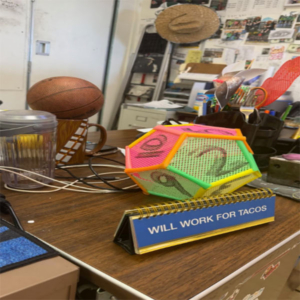
Earl Hills of SOU Ashland and fun on his deskEarl did not want to go back to school. He had barely passed high school, mostly because he needed to stay eligible for sports. Football. Wrestling. Track. He wore number seventy two on the line and thought athletics might be his way out until an ACL tear ended that plan.

School, for him, had always been muffled.

He was deaf in one ear and hard of hearing in the other. Before the IDEA Act, before sophisticated amplification, he wore basic hearing aids that made things louder but not clearer. His mind drifted. Teachers noticed something was wrong early. He learned how to look normal.

It took him decades to understand that normal was the wrong goal.

At Rogue Community College, he started over. Basic English. Remedial math. Classes that did not count toward a degree. He was older than most of the room. His wife’s paycheck kept the family afloat. He relied on mentorship and disability services not as favors, but as structures that made learning possible.

It took more than two years before his credits counted.

When he transferred to Southern Oregon University, math finally clicked. Not because it was easy, but because faculty stood with him. Humor mattered. Time mattered. Being treated as capable, not fragile, mattered. For the first time, struggle was not read as failure but as information.

Then the world shut down.

His first year of teaching happened on screens, with no runway. He learned the systems while they were breaking.

Later that same day, after finishing his lesson from the school building, his phone buzzed again.

When you get home, load the trailer. We have to go.

The Almeda Fire was moving. Their house was one street from evacuation. Earl remembers his youngest panicking, trying to grab everything. He remembers telling her they could not take everything. He remembers keeping his voice calm so his kids could borrow it.

That is the reality of teaching in the Rogue Valley. You do not just teach through curriculum. You teach through smoke.

A few days ago, walking out of Scenic Middle School in mid-February, the valley looked clear again. From the parking lot, you could see Mount McLoughlin rising behind the hills. From Central Point, it is distant but unmistakable, the only peak with a white crest that day, holding the sky in place. The kind of landmark that reminds you where you are and that you are still here.

Earl’s classroom feels like that.

It is not quiet, but it is steady. Star Wars posters on the walls. SpongeBob nearby. In the corner, a Baby Yoda holding a lifesaver. The message is not subtle. You can laugh here. You can struggle here. You will not drown.

He tells students the truth. He was not good at math. On the wall behind him is a poster about growth mindset, not as decoration but as record. He teaches math because he learned, slowly and publicly, that struggling with something does not mean you cannot become good at it.

He listens differently. He watches posture, timing, silence. He knows when a child is carrying something heavy before the child knows how to say it. He knows when to let a kid step out and when to hold the line.

His mother used to say he had broad shoulders for a reason.

He keeps a folder in his room. Thick. Notes from students. Thank you for being my teacher. Thank you for making me want to come to school. Thank you for being the dad I needed.

He does not describe the folder as pride.

He describes it as responsibility.

On his desk is a gray rubber mallet, the kind used when you need force without damage. He calls it the hammer. It is loud enough to get attention, soft enough not to break anything. A tool chosen by someone who knows exactly what happens when you hit too hard.

Earl Hills does not deliver things anymore.

When the system fails. When the fire comes. When a child walks in carrying a world he cannot hear but can still see.

He keeps the kids on the line.

Story by Bryce Smedley, SOU School of Education